Author

admin

Browsing

The ballot box battle for the House majority resumes this week.

Special U.S. House contests in Georgia and New Jersey and a Virginia referendum that is the latest face-off between President Donald Trump and Republicans and Democrats in the high-stakes congressional redistricting wars — with the House majority on the line — will all draw national attention this month.

Also on tap in April: a state Supreme Court election in battleground Wisconsin.

The consequential elections come as the 2026 primary calendar, which kicked off in March, takes a break this month before returning with a vengeance in May.

TRUMP-BACKED FULLER ADVANCES IN RACE TO FILL MTG’S CONGRESSIONAL SEAT

Here’s a closer look at the four ballot box showdowns.

April 7 — GA-14 special election

Trump-backed Republican House candidate Clay Fuller faces off with Democratic candidate Shawn Harris to fill a vacant congressional district in solidly red northwest Georgia that was once held by MAGA firebrand Marjorie Taylor Greene.

Harris, a retired brigadier general and cattle farmer, and Fuller, a local prosecutor and Air National Guard member, were the top two finishers in a field of 17 candidates, including 12 Republicans, in the early March special election. With no candidate topping 50%, Harris and Fuller advanced to a runoff.

SPECIAL ELECTION TO FILL MARJORIE TAYLOR GREENE’S OLD SEAT IN CONGRESS HEADS INTO OVERTIME

The special election comes as Republicans cling to a razor-thin 218–214 majority in the House. That means the GOP cannot afford any surprises or allow Democrats to pull an upset in a district that extends from Atlanta’s northwest exurbs to Georgia’s northwestern border with Alabama and northern border with Tennessee, which Trump carried by 37 points in his 2024 presidential victory.

Fuller, who is expected to consolidate the Republican vote that was divided in the first round, is considered the clear frontrunner in the race. But if Harris holds Fuller’s margin to the mid-teens or less, national Democrats will argue the election is the latest in the 14 months since Trump returned to the White House in which they’ve overperformed.

The congressional seat was left vacant when Greene stepped down at the beginning of January. Greene quit Congress with a year left in her term, after a very public falling out with Trump mostly over her push to release the Jeffrey Epstein files.

April 7 — Wisconsin Supreme Court election

While officially a non-partisan contest, state Supreme Court elections in the Midwestern battleground have become extremely partisan in recent years.

HEAD HERE FOR THE LATEST FOX NEWS REPORTING FROM THE CAMPAIGN TRAIL

With the court’s majority on the line in last year’s contests, outside money poured in and out-of-state door knockers blanketed Wisconsin. One of the biggest spenders was Trump ally Elon Musk, who headlined a rally days before the election and donned a cheesehead hat worn by fans of the Green Bay Packers.

Democrats won that election by a larger-than-expected margin and currently hold a 4-3 majority on Wisconsin’s highest court.

With a conservative justice retiring, the majority isn’t at stake in this year’s election, although liberals with a win could expand their majority to 5-2.

But if the conservative candidate wins, or keeps it close, the GOP may claim a moral victory.

April 16 — NJ-11 special election

Republican Joe Hathaway, a local mayor, is hoping to pull off an upset in the special election to fill the congressional seat left vacant after now-Gov. Mikie Sherrill stepped down after winning last November’s gubernatorial election.

Hathaway, who was unopposed in February’s primary, faces off in the election against Democrat Analilia Mejia, a progressive organizer backed by left-wing champions Sen. Bernie Sanders and Rep. Alexandria Ocasio-Cortez.

Mejia pulled off an upset, narrowly edging out front-runner former Rep. Tom Malinowski in a field of 11 candidates. The face-off was one of the latest between progressives and more mainstream Democrats.

The 11th Congressional District in northern New Jersey‘s New York City suburbs was once the kind of seat where Republicans excelled at the ballot box. Hathaway, who has pointed out his differences with Trump, is the type of Republican who could attract crossover voters.

Add in that Mejia may be too far to the left for some voters in the district, and there’s a chance for some intrigue on Election Day.

April 21 — Virginia redistricting referendum

Voters in Virginia are casting ballots on a Democrat-pushed referendum that would give the competitive state up to four more left-leaning U.S. House districts in time for this year’s midterm elections.

That could result in a 10-1 advantage for Democrats in the state’s U.S. House delegation, up from their current 6-5 edge. 

With two weeks until Election Day, early voting is surging, according to officials, with turnout outpacing early voting from last autumn’s general election. Despite being vastly outraised by Democrats, Republicans see positive signs in early turnout.

Republicans call the Democrats’ redistricting effort an “unconstitutional power grab.” Democrats counter that it’s a necessary step to balance out partisan gerrymandering already implemented in other states by the GOP.

Virginia is the latest redistricting battleground, with Florida on deck, to alter congressional maps ahead of November’s elections.

Republicans are defending their razor-thin House majority in the midterms, and Democrats need a net gain of just three seats to win back control of the chamber. That means the redistricting efforts in Virginia and other states may very well decide which party controls the House next year.

President Donald Trump touted the “historic” rescue of the downed F-15E airmen behind enemy lines and issued a warning to Iran to make a deal before Tuesday night’s 8 p.m. ET deadline or face being “taken out.”

“This is a rescue that’s very historic,” Trump told the White House press corps in a Monday news conference. “It’ll go down to the books.”

“Late Thursday night, an American F-15 fighter jet went down deep inside enemy territory in Iran while participating in Operation Epic Fury, where we’re doing unbelievably well. Well, at a level that nobody’s ever seen before.”

Trump quickly paused his hailing of the rescue to add a warning for Iran to come to peace.

TRUMP REVEALS IRAN MADE ‘SIGNIFICANT PROPOSAL’ AFTER ULTIMATUM, BUT ‘NOT GOOD ENOUGH’

“The entire country can be taken out in one night, and that night might be tomorrow night,” Trump said.

Trump continued to press Iran to come to a peace deal, hours after saying the offers thus far are “not enough,” and War Secretary Pete Hegseth vowed the heaviest bombing of Iran to date.

TRUMP SAYS IRAN ‘NO LONGER A THREAT’ AFTER 32 DAYS — OUTLINES NEXT PHASE OF US WAR

“By the way, per the president’s direction, [Monday] will be the largest volume of strikes since day one of this operation,” Hegseth vowed, taking the mic just before Chair of the Joint Chiefs of Staff Gen. Dan “Raizin’” Caine. 

“Tomorrow, even more than today. And then Iran has a choice,” Hegseth added. “Choose wisely, because this president does not play around. You can ask Soleimani, you can ask Maduro. You can ask Khamenei.”

Trump, responding to a question from Fox News, noted there were military leaders warning against the dangerous exfiltration of the two airmen, citing the risks to a multitude of troops.

“There were military people, very professional, that preferred not doing it: These two were totally on board, which was very important,” Trump said, noting Hegseth and Gen. Caine. 

IDF CONFIRMS IRGC INTEL CHIEF KILLED; QUDS FORCE COMMANDER ALSO ELIMINATED IN STRIKE

“But, no, there were military people that said, ‘You just don’t do this; you don’t go into the heart of a very powerful military.”

Trump noted that “half the people are wearing uniforms” in Iran, exacerbating the challenges of extracting the American airmen.

“I was surprised somebody said it’s the only time it’s ever been done,” Trump continued. “I said, that’s not possible, but it is possible because you’re going into hundreds of thousands of soldiers along the path. I mean, look at some of the helicopters, how they got hit.”

Trump, in a moment that went from serious to lighter, asked Caine “how many” people conducted the rescue.

INSIDE THE DARING RESCUE OF AIRMAN BEHIND ENEMY LINES: HOW CIA ASSISTED WITH ‘DECEPTION CAMPAIGN’

“I’d love to keep that a secret,” Caine shot back.

“I’ll keep it a secret, but it was hundreds and hundreds of these people,” Trump said. 

“Hundreds of people went into this journey. Hundreds of people could have been killed. Forget about the equipment. A lot of equipment. Nobody cares of it. Hundreds of people could have been killed,” Trump added.

“So we had people that were within the military that said, ‘This is not a wise move,’” Trump said.

“And I understood that, but I decided to do it.”

Attorney General Pam Bondi’s departure last week was the latest in a series of high-profile firings or resignations of America’s top law enforcement officer, from a key Watergate figure to a well-respected attorney whose differences with the president became irreconcilable.

Former President George Washington appointed Founding Father and former Virginia Gov. Edmund Randolph the nation’s first attorney general in 1789, and in the years since, there have been dozens of successors, some lost to history and others more memorable.

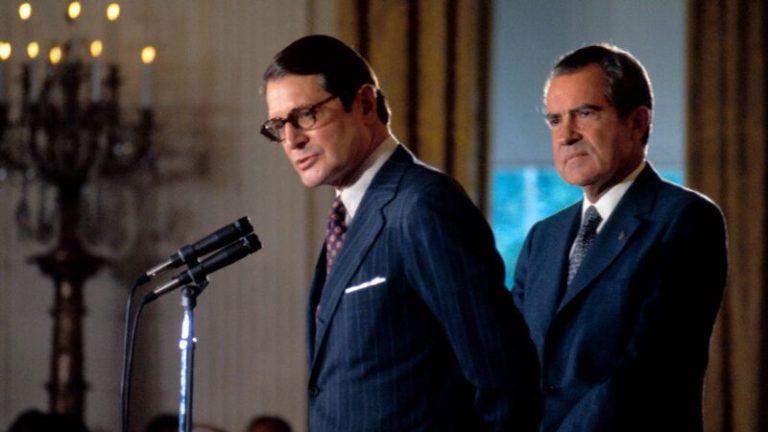
Eliot Richardson and Richard Kleindienst — Nixon

Eliot Richardson, the secretary of defense at the time of the Watergate burglary, was named to succeed Attorney General Richard Kleindienst, who resigned amid the scandal after reportedly being pressured by a member of the Watergate “plumbers” to assuage the situation.

“Plumbers” was the moniker for the group accused in the burglary at the DNC headquarters, then located at the Watergate Hotel in Foggy Bottom, D.C. They were organized by CIA officer E. Howard Hunt and FBI agent-turned-future conservative talk radio star G. Gordon Liddy. The name purportedly came from the dual meaning of “leaks” — political versus pipes.

TOP DOJ OFFICIALS TO BRIEF HOUSE OVERSIGHT COMMITTEE FOR JEFFREY EPSTEIN PROBE

Kleindienst was playing golf at Burning Tree in Bethesda, Md., in June 1972 when Liddy reportedly approached him to say that the Committee to Re-elect the President (Nixon’s committee) was involved in the burglary, according to an account from the UK Guardian.

Kleindienst reportedly told the G-man to get lost, and the federal investigation ensued as normal.

As the scandal raged on April 30, 1973, Nixon announced he had accepted the resignations of Kleindienst, and presidential assistants John Ehrlichman and H.R. Haldeman — and fired White House Counsel John Dean — who has often called President Donald Trump’s tenure worse than that of his old boss.

“Mr. Kleindienst asked to be relieved as Attorney General because he felt that he could not appropriately continue as head of the Justice Department now that it appears its investigation of the Watergate and related cases may implicate individuals with whom he has had a close personal and professional association,” Nixon said in a public letter that day.

Richardson’s tenure began thereafter and ended with one of the most significant executive branch departures in history: the “Saturday Night Massacre.”

On October 20, 1973, Nixon ordered Richardson to fire Watergate special prosecutor Archibald Cox shortly after Cox subpoenaed the Oval Office recordings. Richardson, who appointed Cox and reportedly pledged not to fire him without cause, refused and resigned.

TRUMP FIRES JUDGE-PICKED US ATTORNEY AS TOP DOJ OFFICIAL WARNS COURTS TO STAY IN THEIR LANE

Nixon then asked Richardson’s deputy, William Ruckelshaus, to fire Cox, and he also resigned instead of carrying out the order.

Nixon then ordered Ruckelshaus’ deputy, Solicitor General Robert Bork, who is better known for his unsuccessful nomination to the Supreme Court by President Ronald Reagan, to fire Cox. Bork did so and reportedly considered resigning but stayed on at the urging of his predecessors to ensure stability at the DOJ.

That November, an LBJ-appointed federal judge found that Cox’s firing had been unlawful.

Nixon himself ultimately resigned almost one year later on August 9, 1974.

Richardson’s legacy became that of a cabinet official who, in times of crisis, sacrificed professional status for personal integrity, as described by the Constitution Center and others.

Alberto Gonzales — G.W. Bush

Alberto Gonzales was one of President George W. Bush’s closest advisers, going back to his time as Texas governor. He was also the first Hispanic attorney general and the highest-ranking Hispanic cabinet official until Trump named Marco Rubio to secretary of state in 2025.

Gonzales ultimately resigned the top cop post in 2007 amid mounting bipartisan criticism of the DOJ’s firing of several U.S. attorneys and allegations that he was not forthright during congressional inquiries about whether politics played a role in the firings.

Bush lamented his friend’s resignation, saying “it is sad that we live in a time when a talented and honorable person like Alberto Gonzales is impeded from doing important work because his good name was dragged through the mud for political reasons.”

Gonzales faced mounting pressure and criticism amid the firings and regarding comments defending enhanced interrogation techniques against suspected terrorists.

He stated “I do not recall” or similar framings of the statement dozens of times during a contentious Senate hearing where he battled Republicans like Pennsylvania’s Arlen Specter and Democrats including California’s Dianne Feinstein.

Sen. Charles Schumer, D-N.Y., later confronted Gonzales over his responses.

KARL ROVE: TRUMP DROPPED BONDI, BUT THE REAL POLITICAL FIGHT IS JUST BEGINNING

“You’ve answered ‘I don’t know’ or ‘I can’t recall’ to close to a hundred questions. You’re not familiar with much of the workings of your own department. And we still don’t have convincing explanations of the who, when and why, in regard to the firing of the majority of the eight U.S. attorneys,” Schumer fumed, according to a transcript posted to the left-wing outlet DemocracyNow.

In his testimony, Gonzales said U.S. Attorneys indeed serve at the pleasure of the president, and that the Justice Department makes “decisions based on the evidence, not whether the target is a Republican or a Democrat.”

“I know that I did not, and would not, ask for a resignation of any individual in order to interfere with or influence a particular prosecution for partisan political gain,” Gonzales said. “I also have no basis to believe that anyone involved in this process sought the removal of a U.S. Attorney for an improper reason.”

Bush nonetheless remained behind his pick, rebuking a “no confidence” resolution drafted by Schumer, Feinstein and Sen. Sheldon Whitehouse, D-R.I. as the controversy continued.

Ultimately, Gonzales announced on August 27, 2007, that he would be stepping down on September 17.

“Yesterday I met with President Bush and informed him of my decision to conclude my government service as attorney general… let me say that it’s been one of my greatest privileges to lead the Department of Justice,” Gonzales said in his resignation announcement.

“I have great admiration and respect for the men and women who work here. I have made a point as attorney general to personally meet as many of them as possible, and today I want to again thank them for their service to our nation.”

Jeff Sessions — Trump

Former Alabama Sen. Jeff Sessions was the first in the upper chamber to endorse then-developer Donald Trump in his 2016 presidential bid.

The immigration enforcement hardliner and Trump loyalist, however, saw his relationship with the new president fray early in their term.

Sessions recused himself from the Trump-Russia investigation, citing his own campaigning for Trump amid reports he also met personally with Russian envoy Sergey Kislyak.

The recusal incensed Trump and led him to regularly bash Sessions in the press, and also to blame Sessions for the appointment of former FBI Director Robert Mueller III as special counsel in the Russia case.

Trump also faulted Sessions for declining to criminally pursue Hillary Clinton.

Sessions’ tenure ended the day after Republicans lost the House in the 2018 midterm elections, but left the Alabamian with a successful professional record in reversing Obama-era policies and cracking down on sanctuary city policies.

US INTERIM ATTORNEY GENERAL TODD BLANCHE CALLS SPECULATION SURROUNDING BONDI’S FIRING ‘SIMPLY NOT TRUE’

But Trump’s firing of Sessions only further invigorated his Democratic critics, as New Jersey Sen. Cory Booker called it an “alarming development that brings us one step closer to a constitutional crisis.”

Booker claimed Trump fired Sessions because he was scared Mueller would “implicat[e]” him in the Russia investigation.

William Barr — Trump

Former Attorney General William Barr resigned from his second tenure as the nation’s top cop in December 2020, amid disputes over whether the prior month’s election had been subject to widespread fraud.

Barr, who previously served under President George H.W. Bush, appeared to irritate Trump when he told The Associated Press he had not seen “fraud on a scale that could have effected a different outcome in the election.”

In announcing the departure, Trump tweeted that he had a “nice meeting” with Barr and that his relationship “has been a very good one; he has done an outstanding job.”

Barr also touted Trump’s first-term record amid what he called a “partisan onslaught” and “relentless, implacable resistance.”

In comments to NBC News in 2022 ahead of the release of his book “One Damn Thing After Another,” Barr said he told Trump at the White House that he understood the president was frustrated with him, and that he was willing to submit his resignation.

“Accepted,” Trump supposedly said, but the president himself reportedly claimed he asked for Barr’s resignation, not that the AG quit.

PAM BONDI IS OUT AS AG — HERE ARE THE CONTENDERS WHO COULD REPLACE HER

“The absurd lengths to which he took his stolen election claim led to the rioting on Capitol Hill,” Barr said, while adding that Trump’s actions still wouldn’t reach the legal level of “incitement” as claimed by Democrats.

In his resignation letter, Barr applauded Trump’s ability to “weather” the Russia investigation and Democrats’ attempts to “cripple if not oust [the] administration,” and said the president restored the U.S. military and curbed illegal immigration.

Harry Daugherty — Harding and Coolidge

The first attorney general of the modern era to be ousted was Harry Daugherty, a member of President Warren Harding’s administration.

Daugherty was part of the so-called “Ohio Gang” of longtime Harding confidants from his home state.

Daugherty’s fall began amid the Teapot Dome Scandal — the most infamous incident prior to Watergate — which led to the imprisonment of Interior Secretary Albert Fall.

Fall was implicated in low- or no-bid oil leases at Teapot Dome, Wyoming, in 1923, and jailed for accepting bribes from energy companies.

Daugherty was later investigated for allegedly failing to prosecute people involved in Teapot Dome, and was allegedly implicated in a handful of other scandals, including being charged with conspiracy amid the sale of illegal liquor permits during prohibition.

He was also accused of influence peddling and members of the “Ohio Gang” were accused of selling government appointments.

Daugherty’s brother Mal was president of a bank, which was later closed by the state of Ohio after the Senate was unable to “pry” during its investigation into Attorney General Daugherty, according to a 1930 TIME report.

The sibling’s bank recorded “heavy withdrawals” during that time, which caught the attention of regulators in Columbus.

Harry Daugherty ultimately met his ouster after Harding died in office in August 1923.

New President Calvin Coolidge booted him from the DOJ over loss of public trust and refusal to turn over departmental records regarding alleged corruption.

Daugherty was never convicted.

Fourth-generation Iowa farmer Mark Mueller is no stranger to the ups and downs of the agriculture industry. But right now, he thinks America is on the cusp of a farm crisis.

“I am more concerned now than I have been in my 30 years of farming,” Mueller told NBC News.

Even before the Iran war, Mueller said, many farmers felt they were being squeezed. Consolidation in the fertilizer industry and increased competition from abroad have resulted in higher prices for fertilizer and feed — and smaller returns on Mueller’s corn and soybean crops.

Many farmers who couldn’t pay their bills in recent years went under. In 2025, the number of Chapter 12 farm bankruptcies reached 315, according to the American Farm Bureau Federation. That was up 46% from the previous year.

Now, the Iran war is putting even more pressure on farmers.

Before the war, roughly a third of the world’s fertilizer ingredients and a fifth of its oil supplies passed every day through the Strait of Hormuz, a narrow waterway off Iran’s southern coast. But since the U.S. and Israel attacked Iran on Feb. 28, the strait has been effectively closed by Tehran, leaving scores of tankers stranded.

The strait’s closure has driven up global prices for fertilizer and for the diesel fuel that powers most of America’s heavy agricultural equipment.

The double whammy is hitting farmers just as they head into the spring planting season.

“This is that perfect storm where everything comes together and hammers the farmer,” said Mueller, who also serves as the president of the Iowa Corn Growers Association.

Mueller said his fertilizer supplier was selling a nitrogen fertilizer he needs for $795 per ton on Feb. 22, a few days before the war started. At the end of March, it was $990, Mueller said, a nearly $200 jump in just a few weeks.

Meanwhile, the price he’s paying for diesel has jumped, too. Diesel is now averaging $5.51 nationwide, up from $3.76 right before the war, according to AAA.

Mueller said he got most of the fertilizer he needs for spring before the war — but had to buy some at the higher prices. He’s holding off on purchasing the additional fertilizer he needs for summer, hoping prices will come down.

Mark Mueller, a farmer and president of the Iowa Corn Growers Association, thinks America is on the cusp of a farm crisis.Courtesy of Iowa Corn

President Donald Trump’s tariffs have also added to the cost of goods that farmers import from overseas — and frustrated many of the foreign buyers of America’s agricultural products.

“Our government made our life more difficult by walking away from trade deals or instituting tariffs or just basically making our customers angry — our customers being other nations and companies in other nations,” said Mueller.

Lance Lillibridge, a corn and cattle farmer from Vinton, Iowa, told NBC News he plans to use less fertilizer this year.

“I’m probably going to see a reduction in yield,” said Lillibridge. “If there’s not the supply out there, then the price is going to go up.”

If the war continues, the higher prices could ripple through the supply chain and ultimately result in higher prices at the supermarket.

“We’re talking about all the crops and all the food products that we consume on a daily basis,” said Gregory Daco, chief economist at EY-Parthenon.

“Anything that is grown and that requires fertilizers, which is most of everything that we consume, is potentially affected by this rise in fertilizer prices,” said Daco. “And as a result, we may see these prices rise rapidly across grocery stores in the U.S.”

Take corn, for example. If corn prices spike, then feeding cattle becomes more expensive for many farmers. Plus cattle farmers are also dealing with the higher fuel prices. The cost of beef has already hit record highs — in part from shrinking cattle herds and drought — and it could surge even more.

“I worry about how much more consumers will continue to pay for beef,” said Will Harris, a fourth-generation cattle farmer in Bluffton, Georgia. “I think that I can produce it as cheap as anybody else, but I don’t know where consumers draw their lines.”

It may take a while for price increases on the farm to show up at the grocery store. Farmers are just planting their spring crops now, and it could take months for them to be harvested and sent off to distribution centers and eventually grocery stores.

But consumers may see higher prices sooner rather than later, because of higher transport costs with pricier diesel.

“If you’re feeling these costs now, it’s only going to continue to increase as the supply chain fills with higher-cost goods,” said Lillibridge.

“Corn is used in over 4,000 products,” he added. “It’s not just food — it’s industrial products, like your paper that you would put in your printer has cornstarch in it, plastics, just tons of things have industrial uses from corn.”

Economists say the longer the war stretches on, the larger the effects could be.

Newly harvested corn in Inwood, Iowa. Consumers may see higher prices sooner rather than later because of higher transport costs with pricier diesel. Jim West / UCG/Universal Images Group via Getty images file

“Right now, our farmers can get the product — it’s just really expensive,” said Faith Parum, an economist at the American Farm Bureau Federation, an advocacy group for farmers and ranchers. “We’re slowly starting to hear the longer this goes on, we’re also going to have issues with even the availability of the fertilizer.”

That could further strain farmers.

“We’re going on to year four of losses across the farm economy,” said Parum. “It’s going to become harder and harder for them to put a crop in the ground.”

Before the war, the Agriculture Department estimated that farm sector debt could reach a record $624.7 billion in 2026.

Farmers have received some financial assistance from the federal government over the years. In December, the Trump administration announced a new tranche of $12 billion in aid to farmers.

At a White House event for farmers in March, Trump said that he would push for more aid and urged Congress to pass a new farm bill.

Trump also pledged to ask Congress to permit year-round sales of E15, an unleaded fuel blended with 15% ethanol that the American Farm Bureau Federation says could save consumers money at the gas pump and create markets for American-grown crops.

Farmers listen as President Donald Trump speaks at the White House on Friday. During the event, Trump urged Congress to pass a new farm bill. Alex Wong / Getty Images

Mueller was among the farmers last month at the White House, where he listened to Trump.

“I guess I would liken it to empty calories,” he said of the president’s remarks. “It was like a pep rally with very little being said.”

Mueller fears that the mounting pressures on farmers, exacerbated by the war, could lead some to hang up their hats for good.

“I really do see fewer farmers when it’s all done,” he said. “In the end, the consumer will still have fewer choices, probably have a little higher prices, and farmers will have less margin than they did before.”

The United States added 178,000 jobs in March, blowing past expectations and showing a resilient labor market just as the war with Iran began escalating, sending up oil prices.

The unemployment rate fell to 4.3% last month, down from 4.4%. The gains were concentrated in health care, construction, transportation and warehousing.

Despite the outsized headline figure, there were further indications that the job market remains wobbly. Wage growth declined to 3.5% in March from 3.8% in February, falling short of forecasts.

Jobs report estimates from January and February were also revised, upward and downward respectively. Combined, they show that U.S. payrolls fell by a net 7,000 over those two months.

The labor force participation rate, or the share of the overall population either employed or looking for work, fell to its lowest level since November of 2021.

“While this month’s jobs report delivered an upside surprise, we continue to believe that risks to the labor market remain elevated and higher oil prices from the Iran conflict could prove an additional impediment in the months ahead,” Scott Helfstein, head of investment strategy at Global X financial group, said in a note to clients.

Surveys conducted by the BLS for this report were completed by March 12. At the time, the full brunt of the war had yet to hit the job market.

Three weeks later, gasoline prices have surged to more than $4 a gallon, a level that, if it is sustained, would sap U.S. consumers of hundreds of dollars in annual discretionary income.

On Wednesday, the Atlanta Federal Reserve lowered its real-time gross domestic product estimate to 1.9%, down from more than 3% just before the start of the war.

On Tuesday, the BLS reported the hiring rate in February fell to just 3.1% of the U.S. workforce, a level last recorded in April 2020, as the Covid pandemic bore down.

Job openings also fell in February, though they appear to be stabilizing overall. The rate of layoffs also remains at an all-time low.

Meanwhile, many Americans’ views of the economy and Trump’s handling of it continue to sink to new depths.

A CNN poll out this week found that just 31% of respondents approved of how Trump is managing U.S. economic performance, with just 27% saying they approved of his handling of inflation, down from 44% a year ago. His overall approval rating appears to have stabilized at about 35%.

A construction worker at a new building in Pasadena, Calif.Mario Tama / Getty Images file

A debate is now underway about how many jobs the U.S. would need to add each month to keep the unemployment rate — 4.3% as of Friday — stable.

Over the past year, a massive drop in overall immigration to the U.S., coupled with a growing number of baby boomers leaving the workforce, mean fewer overall jobs need to be created for the economy to absorb newcomers to the labor force and keep the overall unemployment rate steady, according to economists with the Dallas Federal Reserve.

That overall number of new jobs needed is known as the “breakeven” employment rate. The economists wrote in a note published this week that the breakeven employment rate now may be close to zero.

If the overall workforce continues to shrink, even fewer new jobs will be needed to incorporate workers entering the labor force, such as recent college graduates or parents who put their careers on hold for a few years.

That won’t necessarily make looking for a job any easier. The median spell of unemployment is now about 2½ months, with the average much longer — about six months. About 25% of all unemployed workers are out of work for at least 27 weeks.

Oil prices surged Thursday, threatening to further drive up the price of gas as hopes for a near-term resolution to the Iran war faded following President Donald Trump’s address to the nation.

Stocks were volatile, with major indexes plunging early in the day before moving higher at the close on shifting headlines about the war in the Middle East.

U.S. indexes recovered their early losses on news that Iran’s deputy foreign minister said his country would outline a “new navigation regime” in the Strait of Hormuz after the war ended, injecting fresh optimism into markets over the future of the key waterway.

At the closing bell at 4 p.m. ET, the S&P 500 closed up 0.11%, the Nasdaq Composite ended higher by 0.18%, and the Dow Jones Industrial Average fell 61 points. The Russell 2000 index, which tracks smaller companies, rose 0.7%.

Savannah Guthrie returned to the “TODAY” anchor desk Monday, more than two months after her mother disappeared.

“We are so glad you started your week with us, and it is good to be home,” Guthrie said at the start of the show. She wore a bright yellow dress, echoing the yellow ribbons and flowers left at her mother’s home.

“TODAY” co-anchor Craig Melvin, wearing a yellow tie, patted Guthrie’s hand and replied: “Yes, it is good to have you at home.”

The two anchors then turned to the morning’s top headlines, including an opening segment about the U.S.-Israeli war with Iran. “Well, here we go, ready or not,” Guthrie said. “Let’s do the news.”

Savannah Guthrie on Monday’s “TODAY.”TODAY

Guthrie, who has co-anchored “TODAY” since 2012, stepped away from her role in early February after Nancy Guthrie, 84, went missing from her home near Tucson, Arizona. Authorities have described the case as a possible kidnapping or abduction.

Guthrie told Hoda Kotb last month that she believed returning to the “TODAY” anchor desk is “part of my purpose right now,” even though it was difficult to imagine going back to a workplace she associates with “joy and lightness.”

“I can’t come back and try to be something that I’m not. But I can’t not come back because it’s my family,” Guthrie said in the interview, her first since the start of the ordeal. “I don’t know if I can do it. I don’t know if I’ll belong anymore, but I would like to try.”

Savannah Guthrie greets fans Monday in Rockefeller Plaza.TODAY

In the second hour of Monday’s show, Guthrie greeted “TODAY” fans gathered outside on Rockefeller Plaza, some wearing yellow pins and holding signs with her mother’s photo. Guthrie fought back tears as she held co-host Jenna Bush Hager’s hand and thanked her supporters for their prayers and letters.

“You guys have been so beautiful,” she said. “I’ve received so many letters, so much kindness to me and my whole family. We feel it. We feel your prayers.”

Savannah Guthrie walks with Jenna Bush Hager outside the “TODAY” studios.TODAY

Nancy Guthrie’s family reported her missing around noon Feb. 1 after she did not show up at a friend’s house for virtual church services, according to the Pima County Sheriff’s Office. She was last seen the previous night around 9:45 p.m. after having dinner at her daughter Annie Guthrie’s home, according to authorities.

The investigation into her disappearance gripped the nation and put an intense spotlight on the quiet Catalina Foothills area of Tucson. Authorities have not identified a suspect or motive, though the FBI released chilling doorbell camera video of an armed and masked man outside Nancy Guthrie’s home on the morning she was reported missing.

The bureau described him as a man of average build, 5 feet, 9 inches to 5 feet, 10 inches tall, wearing a black Ozark Trail Hiker Pack 25-liter backpack.

Guthrie and her siblings, Camron Guthrie and Annie Guthrie, have provided updates on the case via social media. In emotionally wrenching videos on Instagram, they have thanked members of the public for their prayers and made direct appeals to Nancy Guthrie’s possible abductor.

“Someone knows how to find our mom and bring her home,” Guthrie wrote in the caption to a Feb. 24 video post.

The family is offering up to $1 million for information that leads to the 84-year-old’s recovery. The FBI is offering a reward of up to $100,000 for “information leading to the recovery of Nancy Guthrie and/or the arrest and conviction of anyone involved in her disappearance.”

Kotb, a “TODAY” contributor, substituted for Guthrie. In that period, Guthrie withdrew from NBC’s coverage of the Milan Cortina Winter Olympics; Mary Carillo stepped in to co-host the opening ceremony alongside NBC Sports’ Terry Gannon.

Guthrie visited the “TODAY” set March 5. In photos taken from outside the studio by a photographer for The Associated Press, Guthrie could be seen wiping tears and embracing her colleagues. The visit was not televised.

Savannah Guthrie hugs Al Roker during a visit to “TODAY” on March 5.Charles Sykes / Invision / AP

“I really wanted to come and see everybody. I just love this beautiful place that we call home, where we get to come and be every day,” Guthrie told Kotb, adding: “When times are hard, you want to be with your family.”

Two relatives of slain Iranian Revolutionary Guard Corps Maj. Gen. Qasem Soleimani living in Los Angeles were taken into custody by federal agents after Secretary of State Marco Rubio revoked their green cards, officials said.

Hamideh Soleimani Afshar, identified as Soleimani’s niece, and her daughter were arrested and are now being held by U.S. Immigration and Customs Enforcement (ICE), according to an announcement Saturday from the State Department.

The Trump administration says Afshar has been a supporter of Iran’s “totalitarian, terrorist” regime.

“Afshar is the niece of deceased Iranian Major General Qasem Soleimani,” Rubio wrote on X. “She is also an outspoken supporter of the Iranian regime who celebrated attacks on Americans and referred to our country as the ‘Great Satan.’

RADICAL US MOSQUES HONOR IRAN’S SUPREME LEADER’S ‘MARTYRDOM’ WITH MEMORIAL SERVICES, EULOGY: ‘OUR LEADER’

“This week, I terminated both Afshar and her daughter’s legal status and they are now in ICE custody, pending removal from the United States.”

In January 2020, a U.S. airstrike in Baghdad killed Soleimani during President Donald Trump’s first term in office.

While living in the U.S., Afshar “promoted Iranian regime propaganda, celebrated attacks against American soldiers and military facilities in the Middle East, praised the new Iranian Supreme Leader, denounced America as the ‘Great Satan,’ and voiced her unflinching support for the Islamic Revolutionary Guard Corps, a designated terrorist organization,” the State Department said.

“[Afshar] pushed this propaganda for Iran’s terrorist regime while enjoying a lavish lifestyle in Los Angeles, as attested to by her frequent posting on her recently deleted Instagram account,” the department said.

IRAN VOWS ‘HARSH RETALIATION’ AFTER US AIRSTRIKE KILLS IRANIAN GEN. QASSEM SOLEIMANI

According to the Department of Homeland Security, ICE officers arrested Afshar and her daughter Friday in Los Angeles.

DHS said Afshar entered the U.S. on a tourist visa in June 2015, was granted asylum in 2019 and became a green card holder in 2021 under the Biden administration.

“In July 2025, she filed a naturalization application, where she disclosed she traveled to Iran at least four times since being issued a green card. Her trips to Iran illustrate her asylum claims were fraudulent,” a DHS spokesperson told Fox News.

Her daughter entered the U.S. on a student visa in July 2015, was granted asylum in 2019 and became a green card holder in 2023, according to DHS.

“It is a privilege to be granted a green card to live in the United States of America,” the spokesperson added. “If we have reason to believe a green card holder poses a threat to the U.S., the green card will be revoked.”

FORMER IRANIAN MINISTER PRAISES TRUMP ASSASSINATION FATWA AS DAUGHTER LIVES IN NEW YORK

In addition to revoking Afshar and her daughter’s lawful permanent resident status, officials said Afshar’s husband has been barred from entering the U.S.

Earlier this month, the State Department also terminated the legal status of Fatemeh Ardeshir-Larijani, the daughter of a former senior Iranian official, and her husband.

Both are no longer in the U.S. and are barred from reentry.

“The Trump Administration will not allow our country to become a home for foreign nationals who support anti-American terrorist regimes,” the announcement said.

The State Department and ICE did not immediately respond to Fox News Digital’s request for comment.

The White House on Friday proposed a sweeping fiscal year 2027 budget that would dramatically increase military spending to roughly $1.5 trillion while cutting billions from domestic programs, marking a sharp shift in federal priorities toward national security and border enforcement.

The proposal outlines roughly $1.5 trillion in total defense resources, a figure the administration says is needed to address growing threats from China, Russia and other adversaries.

The request includes about $1.1 trillion in base discretionary funding for the Department of War, along with an additional $350 billion in mandatory funding to support priorities such as munitions production and expansion of the defense industrial base.

TRUMP REWRITES NATIONAL SECURITY PLAYBOOK AS MASS MIGRATION OVERTAKES TERRORISM AS TOP US THREAT

If enacted, the plan would represent one of the largest increases in U.S. defense spending in decades, though the total includes a mix of discretionary funding and mandatory resources that are not typically combined in standard Pentagon budget comparisons.

Weapons production, ships and emerging technologies

The budget places heavy emphasis on rebuilding weapons stockpiles and strengthening domestic manufacturing capacity, areas that defense officials have identified as key vulnerabilities in recent years.

It calls for accelerated procurement of critical munitions and expanded investments in the defense industrial base, alongside increased funding for nuclear modernization.

Shipbuilding is another major focus, with $65.8 billion requested to procure 18 Navy battle force ships and 16 non-battle force vessels as part of a broader effort to expand maritime capacity.

The proposal also continues funding for the “Golden Dome” missile defense system, which aims to develop a layered homeland defense using space-based sensors and interceptors.

Emerging technologies play a central role in the plan. 

The budget highlights investments in artificial intelligence, drones and counter-drone systems, and next-generation aircraft, including continued development of the F-47 — a sixth-generation fighter designed to operate alongside autonomous systems — with the program targeting a first flight as early as 2028.

Defense increases paired with domestic cuts

TRUMP NATIONAL SECURITY BLUEPRINT DECLARES ‘ERA OF MASS MIGRATION IS OVER,’ TARGETS CHINA’S RISE

The increase in defense spending is paired with a proposed 10% reduction in nondefense discretionary spending.

Budget tables show nondefense funding dropping to about $660 billion, while defense-related funding rises significantly, with base defense funding reaching roughly $1.15 trillion. 

The fiscal year 2026 National Defense Authorization Act (NDAA) authorized approximately $890 billion to $901 billion in defense spending. 

The administration also is proposing continued reductions in nondefense spending in future years, signaling a longer-term effort to rebalance federal spending toward national security priorities.

Several major agencies would see significant reductions under the plan, including: NASA, cut by about $5.6 billion, or 23%, State Department and international programs, down roughly $15.5 billion, or 30%, Environmental Protection Agency, cut by more than half, Department of Labor, reduced by about $3.5 billion and Department of Housing and Urban Development, down $10.7 billion.

The reductions are likely to face pushback from lawmakers, particularly over cuts to scientific research, housing programs and foreign aid.

“Donald Trump’s budget is rotten to the core, and Democrats will make sure it never passes,” Senate Majority Leader Chuck Schumer, D-N.Y., said in a statement. “Trump is already spending massive sums on never-ending wars abroad, and now he’s pushing for a record-breaking $1.5 trillion in defense spending while slashing programs that Americans and seniors care about and rely on.”

Border security and law enforcement funding expands

The budget also increases funding tied to immigration enforcement and domestic security.

The Department of Homeland Security would continue to rely on more than $190 billion in multiyear funding provided through prior legislation to support border wall construction, detention capacity and enforcement operations, including tens of thousands of detention beds.

PENTAGON SEEKS AT LEAST $200B FROM CONGRESS FOR IRAN WAR

At the same time, the Department of Justice would receive $40.8 billion in discretionary funding, a 13% increase, with additional resources aimed at addressing violent crime, drug trafficking and cartel activity.

The proposal also includes continued support for military involvement in border operations, as well as expanded funding for the Coast Guard.

Foreign aid reduced as priorities shift

The budget proposes a roughly 30% reduction in funding for the State Department and international programs, including cuts to humanitarian aid, global health initiatives and contributions to international organizations.

At the same time, it creates a new $5 billion fund intended to support strategic partnerships and national security priorities, along with expanded financing for allied nations purchasing U.S. defense equipment.

The changes reflect a broader shift toward prioritizing security-focused spending over traditional foreign assistance programs.

Industrial policy tied to national security

Beyond military spending, the budget links national security more directly to economic and industrial policy.

It includes funding to expand domestic production of critical minerals and support supply chains, alongside investments in advanced computing, including artificial intelligence supercomputers at national laboratories.

Officials say those efforts are intended to reduce reliance on foreign suppliers and improve the United States’ ability to sustain long-term competition with adversaries.

Economic assumptions and next steps

The budget is based on projections that assume steady economic growth of about 3% annually and inflation stabilizing near 2%, estimates that could face scrutiny from outside analysts.

The proposal now moves to Congress, where it is expected to face significant debate over both the scale of defense spending and the extent of domestic cuts.

Lawmakers also will likely scrutinize the administration’s use of mandatory funding and reconciliation to support defense increases, an approach that differs from traditional budget negotiations.

While presidential budgets are rarely enacted as written, the proposal provides a clear outline of the administration’s priorities heading into the next fiscal year, with a focus on military strength, border enforcement and a reduced role for many domestic programs.

The Department of Homeland Security revealed that a suspect who fled to China after allegedly planting a deadly explosive device at a military base is the child of two Chinese illegal immigrants.  

U.S. Immigration and Customs Enforcement arrested Chinese nationals Qiu Qin Zou and Jia Zhang Zheng, both of whom were living in the U.S. illegally, Homeland Security said. 

They were arrested after two of their adult children, Ann Mary Zheng and Alen Zheng, were connected to a failed plot to detonate an improvised explosive device (IED) at MacDill Air Force Base in Florida in mid-March. 

The base is home to U.S. Central Command, which oversees military operations in the Middle East, and Special Operations Command, which oversees all special operations forces across the Department of War.

ICE DETAINS PRESIDENT OF WISCONSIN’S LARGEST MOSQUE, ALLEGING HE HID CONVICTION FOR ATTACKS ON ISRAELIS

The alleged perpetrators of the attempt were born in the U.S. after their parents illegally entered the country, according to the Department of Homeland Security. 

The agency asserted the case “illustrates why the improper recognition of ‘birthright citizenship’ for children of illegal aliens is not only inconsistent with the Constitution, but endangers all Americans.”

Birthright citizenship refers to the principle that anyone born on U.S. soil is automatically granted U.S. citizenship. 

The FBI said Alen Zheng, who is believed to have planted the improvised explosive device at MacDill Air Force Base March 10, is currently in China. He is facing charges of attempted damage to government property by fire or explosion, unlawful making of a destructive device and possession of an unregistered destructive device, which carry a potential sentence of up to 40 years in prison.

FBI Tampa arrested Ann Mary Zheng March 17 after her return to the U.S. from China, where she had fled with her brother. She was charged as an accessory after the fact and tampering with evidence, facing up to 30 years in prison. 

She is accused of hiding or damaging a 2010 Mercedes-Benz to prevent its use in legal proceedings, court documents show. 

Prosecutors allege the siblings attempted to cover their tracks by selling the vehicle to car dealer CarMax. Despite the vehicle being vacuumed and cleaned, investigators later discovered trace explosive residue inside the vehicle.

The day after Ann Mary Zheng’s arrest, ICE apprehended both parents, Qiu Qin Zou and Jia Zhang Zheng. They are in ICE custody, according to the Department of Homeland Security. 

Both parents applied for asylum in the U.S. but were denied and ordered removed by an immigration judge in 1998, according to the agency. 

The Department of Homeland Security said the Bureau of Immigration Appeals denied multiple attempts by the parents to have their case reopened. Despite this, both remained living in the U.S. illegally for nearly three decades.

The department said the case highlights the “grave danger” of current U.S. law granting automatic citizenship to anyone born on American soil, including the children of illegal immigrants.

WATCH: PRESIDENT TRUMP REVEALS FAMILIES OF SLAIN US SERVICE MEMBERS URGED HIM ‘FINISH THE JOB’

After the parents’ arrests, acting Department of Homeland Security Assistant Secretary Lauren Bis said “automatically granting citizenship to children of illegal aliens born in the U.S. … poses a major national security risk.”

“That reality became apparent last week when two U.S.-born children of Chinese illegal aliens were indicted for planting a potentially deadly explosive device outside MacDill Air Force Base in Florida,” said Bis.

“This incident underscores the severe national security threat that illegal immigration and birthright citizenship pose to the United States.”

Bis also asserted that the policy of granting automatic birthright citizenship “is based on a historically inaccurate interpretation of the Citizenship Clause” of the 14th Amendment.

The Supreme Court is weighing the constitutionality of an executive order signed by President Donald Trump that would end birthright citizenship for the children of illegal immigrants. Trump signed the order on his first day back in the Oval Office in 2025. 

PETE HEGSETH SIGNS MEMO OPENING DOOR FOR TROOPS TO CARRY PERSONAL FIREARMS ON BASES

The court held oral arguments on the case Wednesday, and justices appeared skeptical of Trump’s order.

Amy Swearer, a senior legal fellow at Advancing American Freedom, described the court’s line of questioning as “disappointing” for proponents of Trump’s stance on birthright citizenship.

“Most people understood coming into this, and I suspect even the government understood coming into this, that this was probably going to be a bit of an uphill battle,” Swearer said.

“I do think there’s a path forward” for a Trump victory, though it would likely be narrow and partial.

Fox News Digital’s Alex Nitzberg and Alexandra Koch contributed to this report.