

US companies have been delivering one of the strongest earnings seasons in years, but the market response has exposed a problem for anyone still treating a quarterly beat as the main event.
By early August, 86 percent of S&P 500 companies that had reported second quarter results had exceeded earnings estimates, according to FactSet.
That was comfortably above the five-year average of 78 per cent and the ten-year average of 76 per cent.
Yet the reward for getting the quarter right has often been surprisingly thin.
Bloomberg Intelligence found that companies beating revenue, earnings or both generated roughly flat one day excess returns on average during the season, while misses were punished more heavily.
Western Digital, Datadog, SanDisk and DaVita all beat on the top and bottom lines and still sold off.
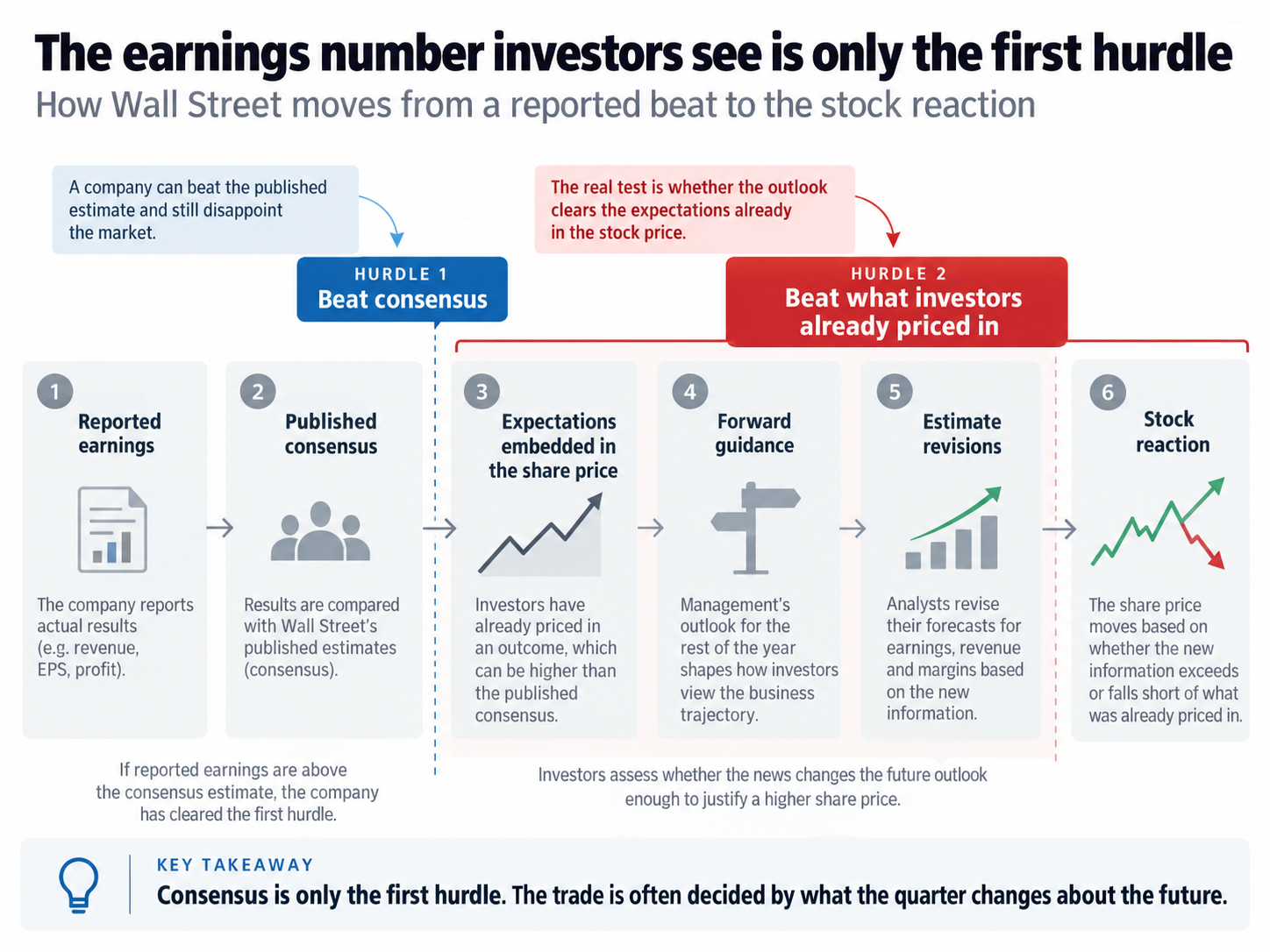
It points to something more important for traders. The published consensus is increasingly only one hurdle.
The market is also judging the expectations already embedded in a share price and, above all, whether management gives investors reason to raise or cut the numbers that come next.
The contrast between Datadog and Nvidia captures the problem. Datadog beat second quarter estimates and raised its full year outlook in August, but its shares still sank as investors focused on a slower growth rate implied for the next quarter.
Nvidia also beat, but its shares surged after management went much further, projecting revenue growth of about 70 per cent in fiscal 2028, far above the roughly 45 per cent analysts had expected.
One failed to clear the market’s invisible hurdle, while the other changed the earnings path investors were modelling years ahead.
When almost everyone beats the beat tells you less
The 86 per cent figure matters because it changes what an earnings surprise actually tells investors.
FactSet said the share of S&P 500 companies reporting positive earnings surprises in the second quarter was running at its highest level since the second quarter of 2021.
Companies were also beating estimates by unusually large margins. The aggregate surprise was distorted by large investment-related gains at Alphabet and Amazon, but even excluding those two companies, earnings were still 10.9 per cent above estimates.
The bar had not been unusually easy either. Analysts raised the bottom-up S&P 500 earnings estimate for the second quarter by 3.4 per cent between the end of March and the end of June.
Historically, analysts tend to cut estimates as a quarter progresses. Over the previous five years, the average reduction had been 2 per cent.
Expectations rose before companies reported, and companies still beat them at a very high rate.
The difficulty is that investors were prepared for much of that strength.
“A lot of the good news has been priced in,” Bank of America strategist Jill Carey Hall told Bloomberg in August.
She said investors had already positioned for strong earnings, helping explain why the reward for subsequent beats was more muted than usual.
That asymmetry matters to traders, as a beat may confirm what the market already believes, but a miss can destroy that belief.
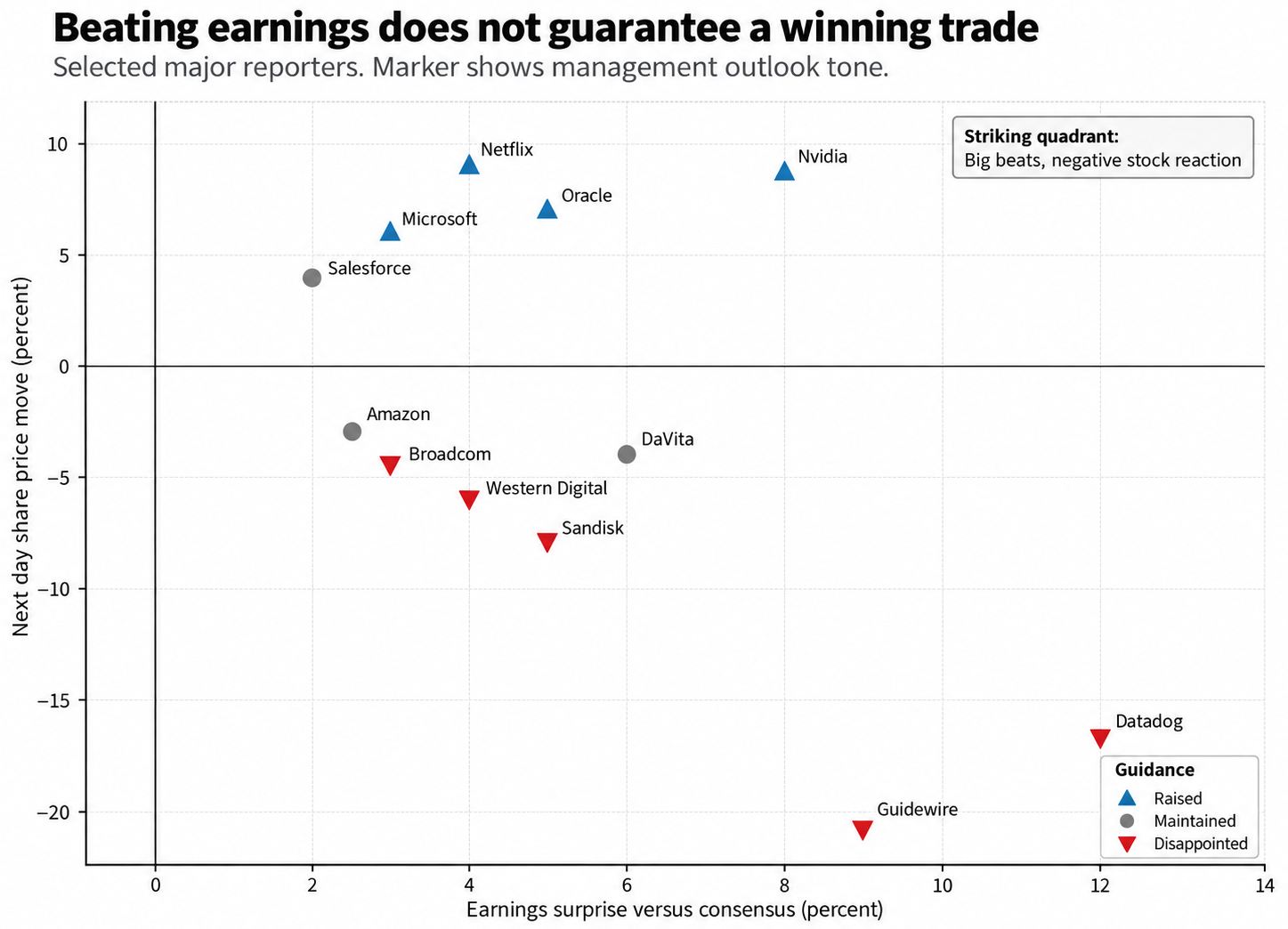
Larry Adam, chief investment officer at Raymond James, highlighted the same pressure before the reporting season accelerated, writing in a July market note that “with earnings expectations already at lofty levels, guidance will be key.”
The point is not that consensus has become useless. It remains the cleanest public benchmark for measuring the quarter.
But when beat rates become extremely high, the question shifts from whether a company cleared that benchmark to what was not already anticipated.
ActivTrades market analyst Ion Jauregui put it directly in comments to Invezz.
“Strong earnings are no longer enough to guarantee a positive share-price reaction.”
The invisible hurdle sits above consensus
Earnings are normally presented as a contest between one actual number and one consensus number. Reality is messier.
Consensus is an observable average of published analyst forecasts.
The price of a stock reflects something broader: the expectations of mutual funds, hedge funds, retail traders, quant strategies, options markets and investors who may have very different assumptions about growth, margins and valuation.
“The key issue is the expectations gap: a company can beat analysts’ published forecasts and still disappoint the market if investors had it already priced in even stronger growth, margins, guidance or cash flow,” Jauregui told Invezz.
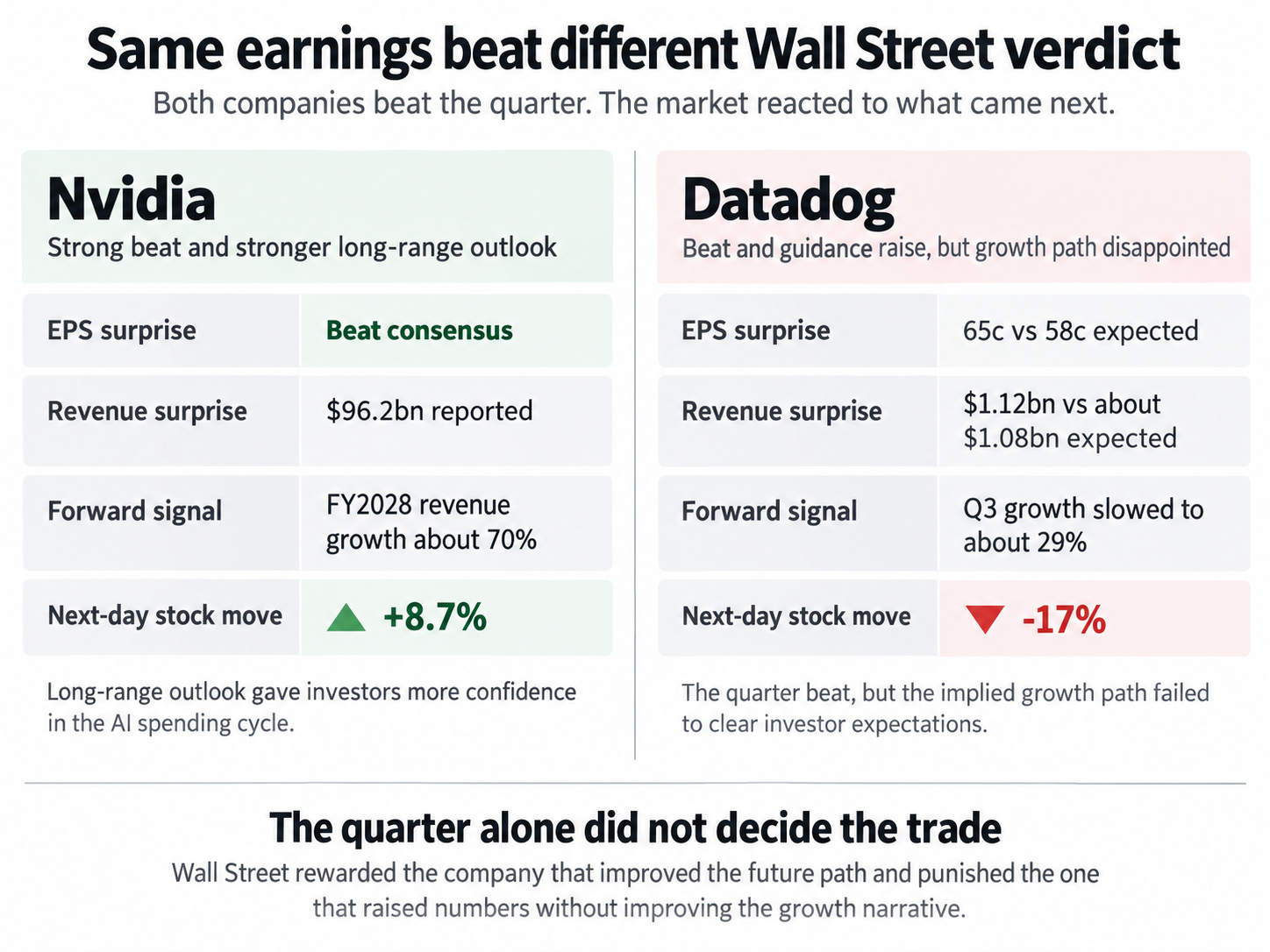
Datadog is a useful case because it shows why even a beat and raise can fail.
The cloud monitoring company reported second quarter adjusted earnings of 65 cents a share against a 58-cent consensus and revenue of $1.12 billion versus expectations of about $1.08 billion. It also raised its full-year revenue and earnings guidance.
The stock nevertheless fell sharply.
The problem was in the trajectory. Datadog guided third-quarter revenue to between $1.135 billion and $1.145 billion.
That was above the published consensus, but the midpoint implied year-on-year growth of roughly 29 per cent, a deceleration from 36 percent in the second quarter.
The shares had more than doubled during 2026 before the report, leaving investors positioned for continued acceleration.
In other words, Datadog beat the analysts’ number but did not beat the expectation embedded in the stock.
“That is why stocks can fall after apparently excellent results,” Jauregui said.
Expert View
The market is not only asking whether the company beat the quarter but also whether the outlook is strong enough to justify its current valuation.
SanDisk offered a more conventional version of the same trade. The company reported fiscal fourth quarter revenue of $8.97 billion and adjusted earnings of $39.25 a share, both ahead of market estimates, but its shares fell after the current quarter outlook disappointed investors.
The lesson is uncomfortable for anyone trading solely around the size of an earnings surprise. The number that appears beside the word beat may not be the number that decides the trade.
Nvidia showed what happens when the future changes
Nvidia’s August results provided the reverse case.
The chipmaker reported second-quarter revenue of $96.2 billion, up 106 per cent from a year earlier, and guided to roughly $108 billion for the third quarter.
Those figures were strong, but the stock’s most important move came as management gave investors something much further out.
On the earnings call, Nvidia said it expected fiscal 2028 revenue to grow approximately 70 percent year on year. Bloomberg data showed analysts had been expecting growth of about 45 percent.
The shares rose 8.7 per cent the following day, adding about $442 billion in market value.
That reaction is revealing because the long range forecast answered a question that the latest quarterly beat could not: whether the extraordinary AI infrastructure cycle had enough momentum to sustain Nvidia’s growth into another year.
“Wall Street has therefore become much more forward-looking,” Jauregui told Invezz.
“In technology and AI especially, investors are increasingly trading expected earnings for 2027 and 2028, not just the latest quarter.”
Not every company is now trading on numbers two years away. For a mature bank, retailer or industrial company, next quarter margins or next year free cash flow may matter much more than a 2028 forecast.
But the underlying mechanism is the same. Earnings day is valuable because it changes assumptions about future profits.
Jauregui sees that dynamic as especially important for technology benchmarks.
“This is particularly important for the Nasdaq 100 index, where AI investment in semiconductors, datacenters, cloud infrastructure and software remains a major source of support.”
Nvidia is an unusually clean example because investors were given an explicit long-range growth figure. Usually, the repricing is subtler.
It happens through revisions to revenue, margins, capex, free cash flow and earnings estimates over the following several quarters.
Wall Street has always looked ahead so what is actually changing
There is an important challenge to the thesis.
Investing has always been forward-looking. A stock represents a claim on future cash flows, and investors have always cared more about what a company will earn than what it has already earned.
Gil Luria, managing director at D.A. Davidson, made that distinction in comments to Invezz.
“Investors have always focused more on outlook than current period results.”
Declaring the death of quarterly earnings would overstate what is happening. Strong current results still establish credibility, as they reveal demand, margins and cash generation, and they give investors evidence for judging management’s forecasts.
Luria’s second observation is more useful for understanding the current market.
“The trend I would point to is that they are more focused on near-term outlooks than long-term outlooks.”
The two views describe different parts of the same market.
In AI and other high-growth areas, valuations can depend on earnings several years ahead, making long-range growth assumptions unusually powerful.
However, across the broader market, investors may be demanding greater visibility into the next quarter or two before accepting longer term stories.
What connects them is the diminishing ability of the reported quarter alone to settle the trade.
That hurdle may also be getting harder because analysts have continued raising forward estimates. FactSet said the bottom up S&P 500 earnings estimate for the third quarter rose 1.2 per cent during July and August.
During the previous five years, estimates had fallen by an average of 1.7 per cent over the comparable period.
Companies are therefore entering the next reporting season with expectations moving higher rather than being quietly reset lower.
The real earnings trade happens after the beat
The old earnings framework encouraged traders to focus on a relatively simple problem: estimate the quarter better than consensus and position for the surprise.
The modern version requires another forecast. A trader must anticipate how the result will change everyone else’s forecasts.
A revenue beat matters if it changes next year’s revenue. A margin surprise matters if it looks sustainable.
Strong cash flow matters if it alters capital allocation or valuation. Guidance matters because it forces analysts to rebuild models that extend well beyond the period being reported.
That makes estimate revisions potentially more important than the headline surprise.
It also explains why apparently contradictory reactions are not necessarily irrational. Datadog could beat and raise yet fall because the market saw deceleration.
Nvidia could initially offer a strong quarter, then rally much more decisively when its fiscal 2028 outlook changed the longer term growth equation.
The same logic applies outside technology. A retailer can beat earnings but fall after warning about consumer demand.
An industrial company can miss the quarter but rise if orders and margins imply a better year ahead. A bank can exceed profit estimates but sell off if net interest income guidance deteriorates.
The quarter is the evidence, but the future is what gets repriced.
That makes today’s high beat rate less reassuring for earnings traders than it initially appears. Eighty six percent of companies can clear consensus without 86 per cent creating positive surprises for investors, because consensus and market expectations are not the same thing.
“The conclusion is simple, beating consensus is no longer enough,” Jauregui told Invezz.
Expert View
Companies must also beat the expectations already embedded in their share price and prove that future growth can justify today’s valuation.
The market has not stopped caring about profits. Nor has guidance suddenly replaced financial results. Instead, the trade has moved one level deeper.
Investors are asking what each quarter says about the sequence of earnings still to come and whether that sequence is good enough for the price they are being asked to pay today.
The post Why the biggest earnings beats are becoming the worst trades on Wall Street appeared first on Invezz