

OpenAI has given its AI agents a way to pay. ChatGPT Wallet, unveiled on Friday, lets the company’s “dots” agents complete purchases for users, provided the user signs off on each one.
OpenAI set out the details in a blog post and a help-centre guide.
Built with American Express, Mastercard and Visa, the feature starts small, but it is OpenAI’s second attempt in just over a year to take ChatGPT from product research to the checkout.
What is ChatGPT Wallet?
ChatGPT Wallet is a payment feature inside dots, the always-on personal agents OpenAI unveiled at its DevDay conference on 29 September.
Until now, a dot that found a sweater or a hotel room still needed a human to finish checkout. With Wallet, users save a card once, and the agent pays through the merchant’s normal checkout.
Cards saved in Wallet are kept separate from the one that pays for the ChatGPT subscription, and from any prepaid ChatGPT balance.
How does ChatGPT Wallet work?
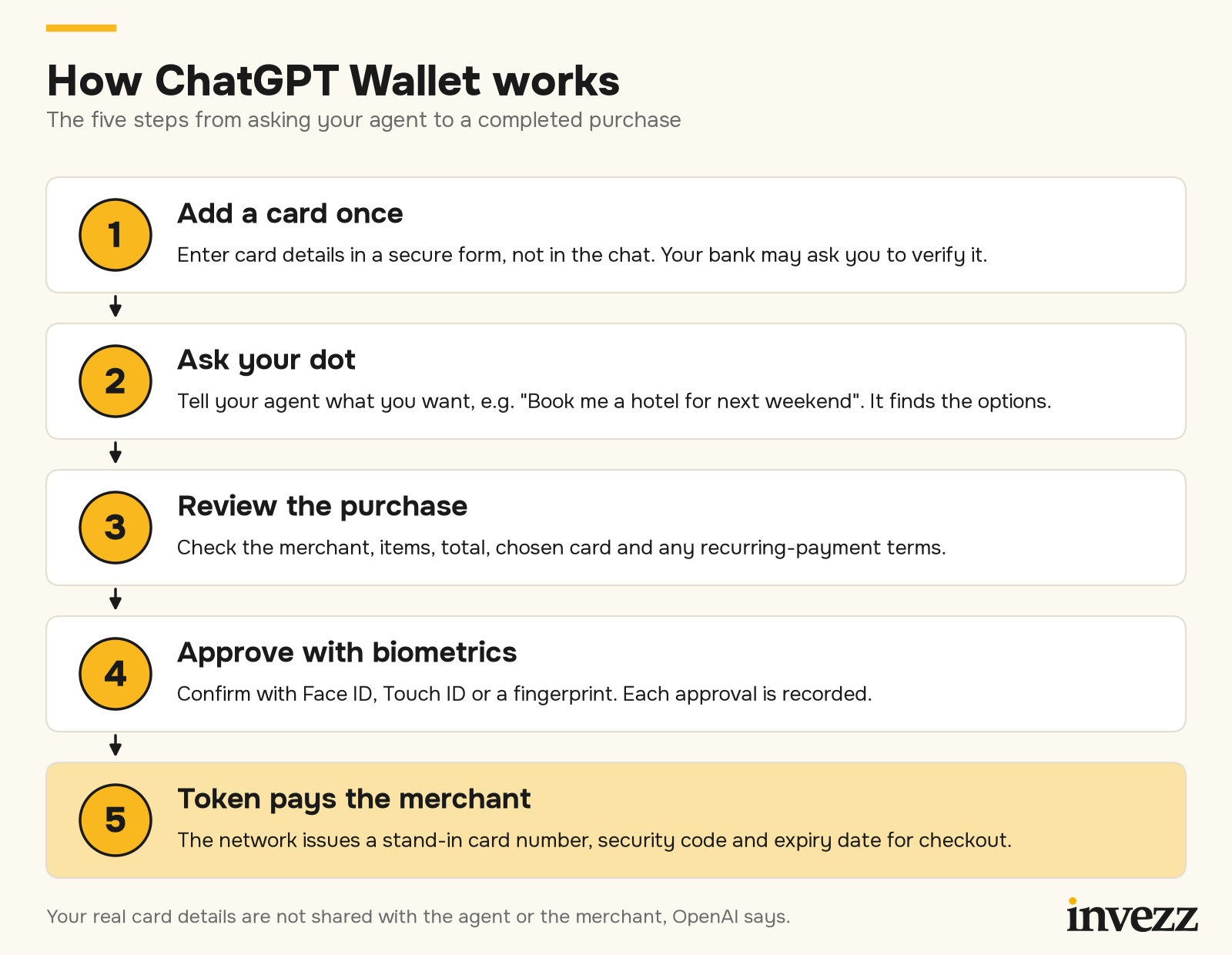
OpenAI’s guidance describes five stages. The user adds a card through a secure form rather than in the chat, and the bank may ask for verification. The user then asks their dot to find something, such as a hotel for a weekend trip.
Before paying, the dot shows the merchant, items, total, chosen card and any recurring-payment terms. The user approves with a biometric check such as Face ID or Touch ID, creating a record of what was authorised.
Finally, the card network issues a payment token, a substitute card number, security code and expiry date, which the agent enters at checkout. The real card details are never shared with the agent or the merchant, OpenAI says.
OpenAI is not taking a fee on transactions at launch, according to CNBC. The sale is between shopper and merchant, which keeps control of pricing, delivery and returns.
Who can use ChatGPT Wallet?
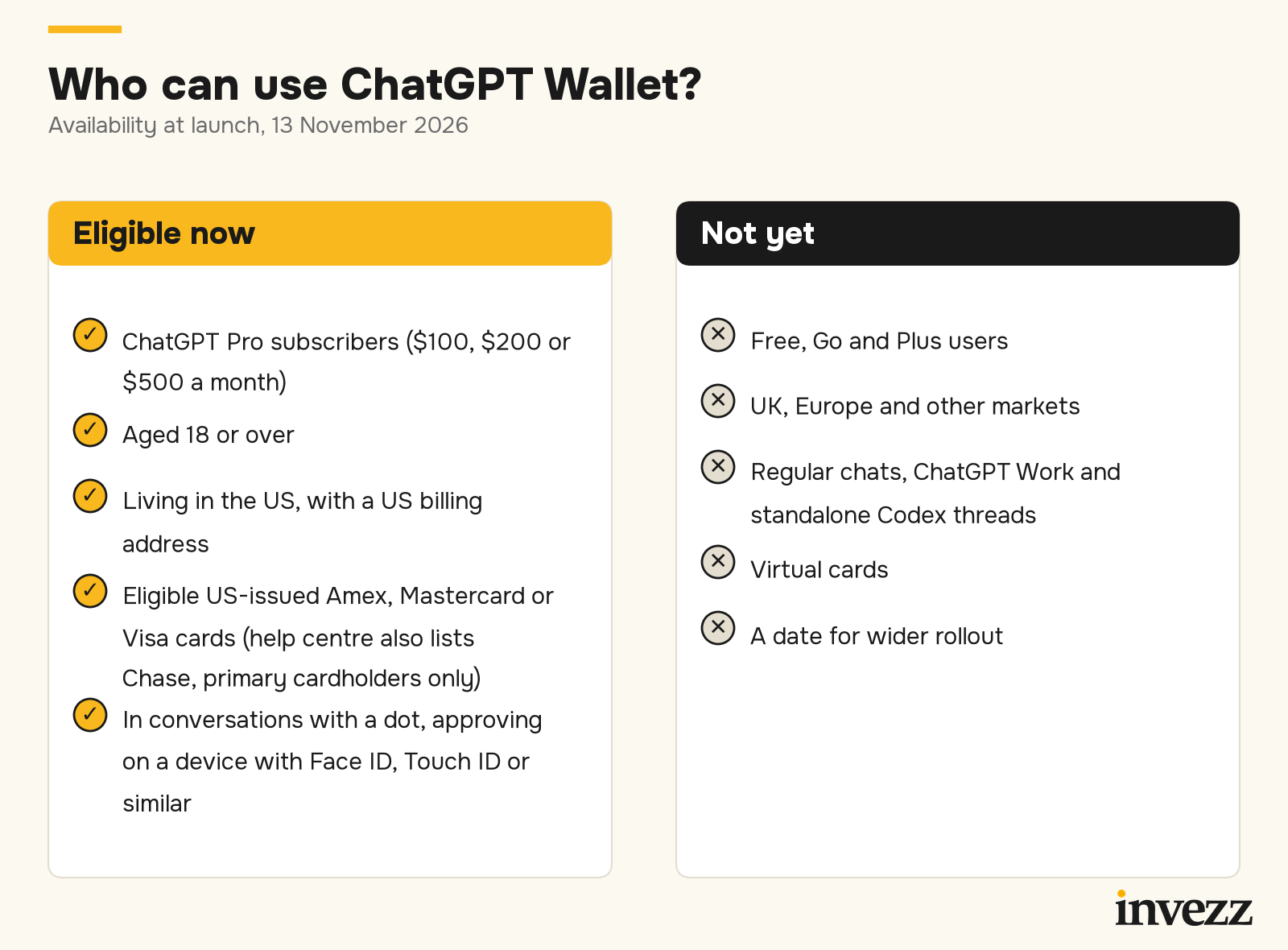
Wallet is open only to ChatGPT Pro subscribers, whose plans cost $100 to $500 a month. Users must be 18 or over, live in the US and hold an eligible US-issued card with a US billing address. It works only in conversations with a dot.
OpenAI’s help centre lists eligible Chase cards for primary cardholders, alongside Amex, Mastercard and Visa. Virtual cards are not supported at launch.
There is no timetable for Free, Go or Plus users, or for the UK and Europe. Amex’s Luke Gebb told CNBC the narrow rollout was deliberate.
What does it mean for consumers?
The main gain is convenience: an agent can take a purchase from search to payment without the user retyping card details.
OpenAI says shoppers keep their card rewards and protections for eligible disputes, such as a faulty item. Refunds go through the merchant, and unrecognised charges through the card issuer.
There are drawbacks. OpenAI concedes some sites may block agents or flag their purchases as fraud. Amazon stops agents buying on its platform, CNBC reported, and United Airlines said this week it would block third-party AI agents from booking. OpenAI also tells users that a “ready to check out” message does not confirm an order.
Privacy is another consideration. Merchants may still need a name, phone number, email and delivery address, which can be passed on through the conversation.
Longer term, OpenAI wants users to pre-approve purchases within spending limits, categories or time windows, so the agent need not ask each time. It has given no date for that.
Why is OpenAI doing this?
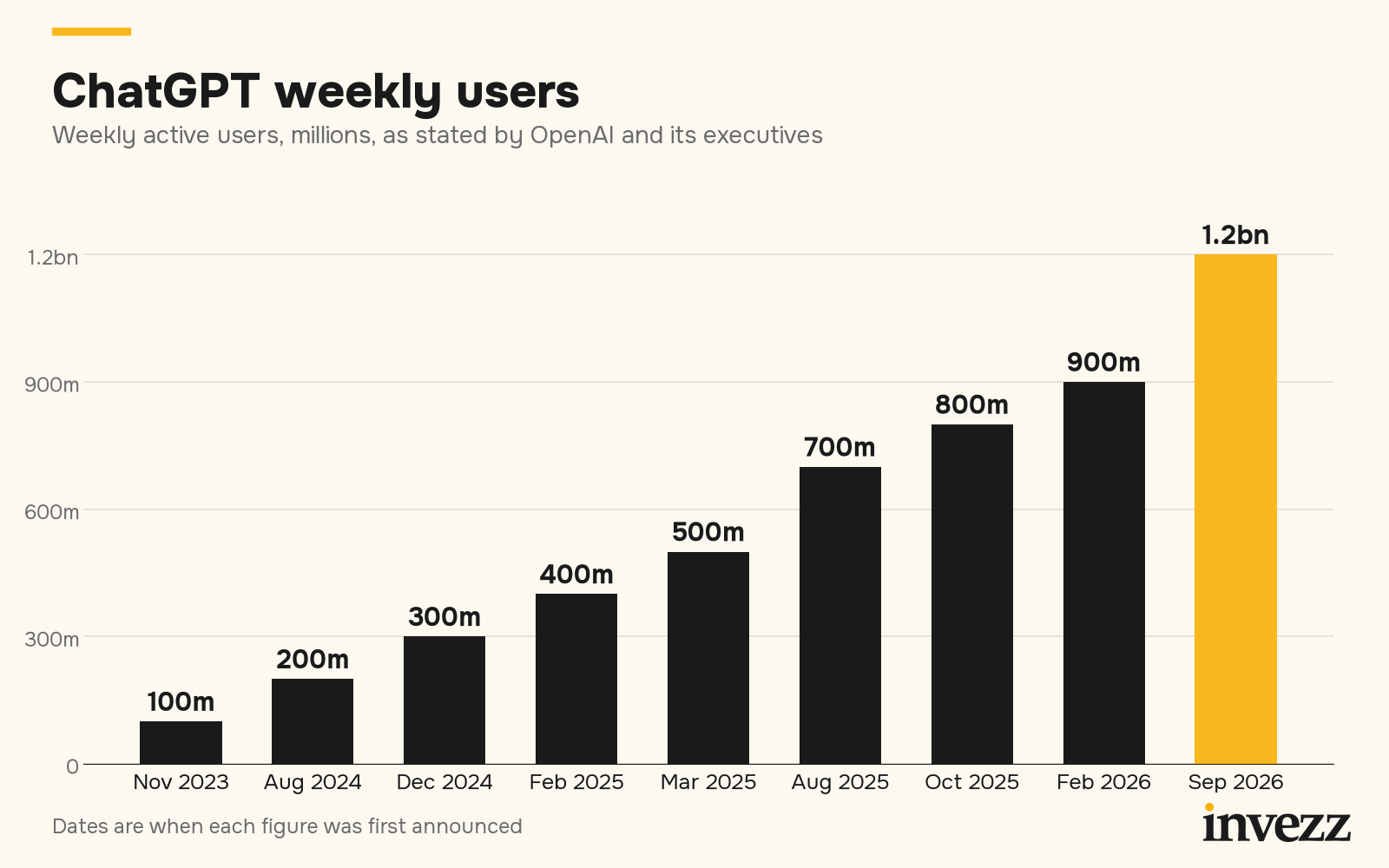
OpenAI says 1.2 billion people use ChatGPT each week, many of them to research what to buy, and it had nearly 100 million paying users at the end of the third quarter, CNBC reported.
Its first checkout push stalled. Instant Checkout, launched in September 2025 with the Agentic Commerce Protocol built alongside Stripe, was wound down in March, when OpenAI said it lacked flexibility for merchants.
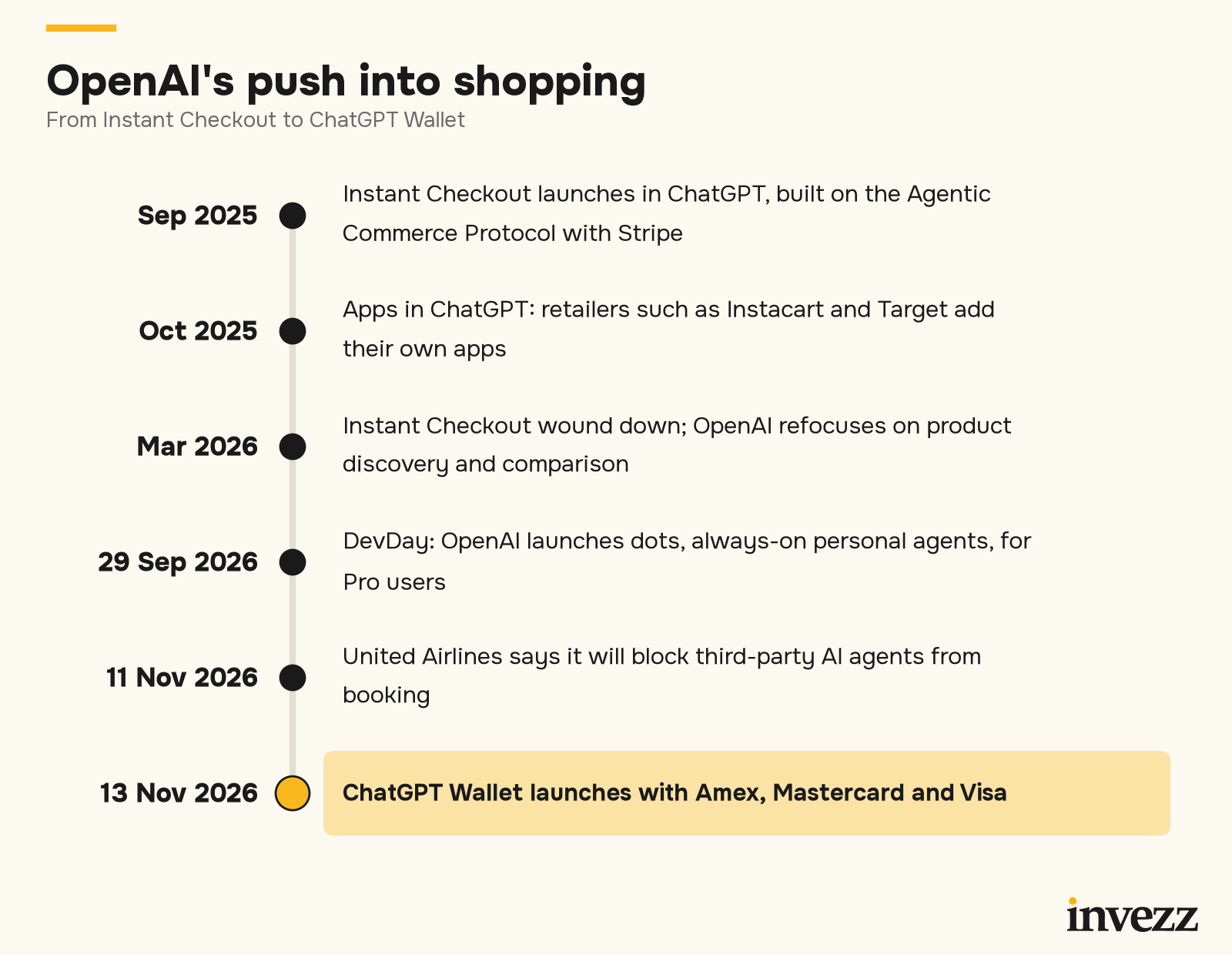
Wallet takes a different route, using merchants’ existing checkouts and the card networks’ token systems. OpenAI is also working with payment firms including Stripe and Adyen, and fraud-prevention specialists such as Forter and Signifyd, so genuine agent purchases are not wrongly declined.
How have markets reacted?
OpenAI is privately held, so attention turned to its listed partners.
At 16:55 GMT, Visa was up 1.4% at $426.20 and Mastercard 1.4% at $661.46 against Thursday’s close, while Amex was 0.5% higher at $319.77, according to Yahoo Finance data.
The moves are modest and cannot be pinned on the launch alone.
What happens next?
OpenAI has published a Commerce Partner Playbook showing merchants how to let its agents through and share product feeds. It says it will widen access once it has learned from early use with businesses, banks and card networks.
AI disclosure: AI tools assisted with research and drafting of this piece. An Invezz editor reviewed the facts, sources and wording before publication. Any opinions or analysis are Invezz’s, not those of an automated system.
The post What is ChatGPT Wallet, how does it work and who can use it? appeared first on Invezz