
Author

admin

Browsing

Thanks to exchange-traded funds (ETFs), investors don’t have to be tied to one specific stock. When it comes to biotech ETFs, they give sector participants exposure to many biotech companies via one vehicle.

ETFs are a popular choice as they allow investors to enter the market more safely compared to investing in standalone stocks. A key advantage is that even if one company in the ETF takes a hit, the impact will be less direct.

All other figures were also current as of that date. Read on to learn more about these investment vehicles.

1. ALPS Medical Breakthroughs ETF (ARCA:SBIO)

AUM: US$95.57 million

Launched in December 2014, the ALPS Medical Breakthroughs ETF tracks small- and mid-cap biotech stocks that have one or more drugs in either Phase II or Phase III US FDA clinical trials. Its holdings must have a market cap between US$200 million and US$5 billion.

There are 102 holdings in this biotech fund, with about 40 percent being small- and micro-cap stocks. Its top holdings include Cytokinetics (NASDAQ:CYTK) at a weight of 3.62 percent, Merus (NASDAQ:MRUS) at 3.51 percent and Avidity Biosciences (NASDAQ:RNA) at 3.43 percent.

2. Tema Oncology ETF (NASDAQ:CANC)

AUM: US$82.42 million

The Tema Oncology ETF provides exposure to biotech companies operating in the oncology industry. Launched in August 2023, it includes companies developing a range of cancer treatments, including CAR-T cell therapies and bispecific antibodies.

There are 51 holdings in this biotechnology fund, of which just over half are small- to mid-cap stocks. Among its top holdings are Revolution Medicines (NASDAQ:RVMD) at a weight of 6.29 percent, Eli Lilly and Company (NYSE:LLY) at 5.47 percent and Genmab (NASDAQ:GMAB) at 5.32 percent.

3. Direxion Daily S&P Biotech Bear 3x Shares (ARCA:LABD)

AUM: US$78.98 million

The Direxion Daily S&P Biotech Bear 3x Shares ETF is designed to provide three times the daily return of the inverse of the S&P Biotechnology Select Industry Index, meaning that the ETF rises in value when the index falls and falls in value when the index rises. Leveraged inverse ETFs are designed for short-term trading and are not suitable for holding long-term. They also carry a high degree of risk as they can be significantly affected by market volatility.

Unlike the other ETFs on this list, LABD achieves its investment objective through holding financial contracts such as futures rather than holding individual stocks.

4. ProShares Ultra NASDAQ Biotechnology (NASDAQ:BIB)

AUM: US$62.42 million

The ProShares Ultra NASDAQ Biotechnology ETF, launched in April 2010, is leveraged to offer twice daily long exposure to the broad-based NASDAQ Biotechnology Index, making it an ideal choice “for investors with a bullish short-term outlook for biotechnology or pharmaceutical companies.” However, analysts also advise investors with a low risk tolerance or a buy-and-hold strategy against investing in this fund due to its unique nature.

Of the 260 holdings in this ETF, the top biotech stocks are Vertex Pharmaceuticals (NASDAQ:VRTX) at a 5.05 percent weight, Amgen (NASDAQ:AMGN) at 5.01 percent and Gilead Sciences (NASDAQ:GILD) at 4.93 percent.

5. Tema Heart and Health ETF (NASDAQ:HRTS)

AUM: US$51.68 million

Launched in November 2023, the Tema GLP-1 Obesity and Cardiometabolic ETF tracks biotech stocks with a focus on diabetes, obesity and cardiovascular diseases. The fund was renamed on March 25 from Tema Cardiovascular and Metabolic ETF, and again on June 27 from the GLP-1 Obesity and Cardiometabolic ETF.

There are 47 holdings in this biotechnology fund, with about 75 percent being large-cap stocks and 22 percent mid-cap. About three-quarters of its holdings are based in the US. Its top biotech holdings are Eli Lilly and Company at a 8.47 percent weight, AstraZeneca (NASDAQ:AZN) at 4.39 percent and Abbott Laboratories (NYSE:ABT) at 4.58 percent.

Securities Disclosure: I, Meagen Seatter, hold no direct investment interest in any company mentioned in this article.

This post appeared first on investingnews.com

The Senate remains deadlocked on a path to end the shutdown as it nears its second week, and Republicans’ meager support across the aisle to reopen the government may be crumbling.

Senate Majority Leader John Thune, R-S.D., needs at least eight Senate Democratic caucus members to join Republicans to reopen the government, given that Sen. Rand Paul, R-Ky., has consistently voted against the GOP’s bill.

So far, a trio of Democratic caucus members, Sens. John Fetterman, D-Pa., Catherine Cortez Masto, D-Nev., and Angus King, I-Maine, have crossed the aisle to reopen the government.

That group has joined Republicans in nearly all five attempts to reopen the government.

But, as time drags on and a deal remains out of reach, at least one is considering changing his vote.

King said ahead of the fifth vote to reopen the government on Monday that he was considering flipping his support of the GOP’s bill, and he argued that he needed ‘more specificity about addressing the problem’ of the expiring Obamacare tax credits.

‘I think this problem is urgent, and just saying, as the leader did on Friday, ‘well, we’ll have conversations about it,’ is not adequate,’ he said.

King’s possible defection comes as Republicans and Democrats engage in low-level conversations on a path out of the shutdown. Those impromptu dialogues have so far not morphed into real negotiations, however.

And the stalemate in the upper chamber has only further solidified both sides’ positions.

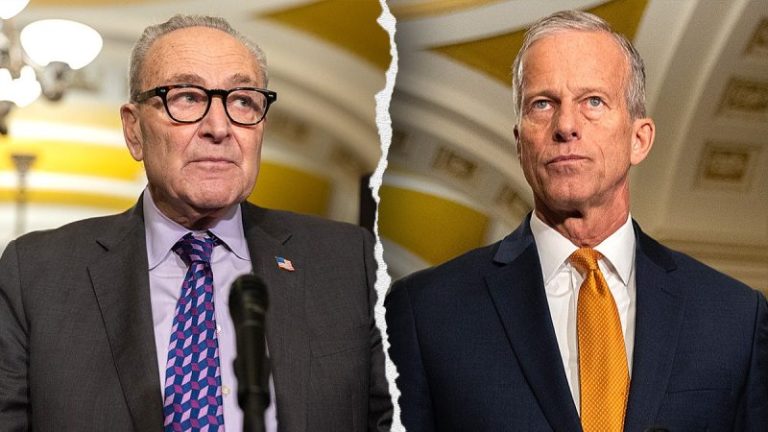
Senate Democrats, led by Senate Minority Leader Chuck Schumer, D-N.Y., want a firm deal in place to extend expiring Obamacare subsidies. Senate Republicans have said that they will negotiate a deal only after the government is reopened and want reforms to the program that they charge has been inflationary and further increased the cost of healthcare for Americans.

Sen. Susan Collins, R-Maine, has circulated an early plan that includes a discussion of the Affordable Care Act (ACA) subsidies that could be a way out of the shutdown, but so far, it’s in its preliminary stages.

‘It suggests that there be a conversation on the ACA extension for the premium tax credits after we reopen the government,’ she said. ‘But there will be a commitment to having that discussion.’

President Donald Trump signaled on Monday that he would be open to a deal on the subsidies, and he said that negotiations with Democrats were ongoing.

However, Schumer pushed back and called Trump’s assertion ‘not true.’ The top Senate Democrat has also shifted the onus of the shutdown, and lack of negotiations, directly onto House Speaker Mike Johnson, R-La.

‘Clearly, at this point, he is the main obstacle,’ Schumer said on the Senate floor. ‘So ending this shutdown will require Donald Trump to step in and push Speaker Johnson to negotiate.’

Meanwhile, the White House is exerting more pressure on Senate Democrats to cave and reopen the government. A new memo reported by Axios suggested that furloughed federal employees may not have to receive back pay, running counter to a law that Trump signed in 2019 that guaranteed furloughed workers would receive back pay in future shutdowns.

That comes on the heels of a memo from the Office of Management and Budget last month that signaled mass firings beyond the typical furloughs of nonessential federal workers, and it follows the withholding of nearly $30 billion in federal funds for blue cities and states.

Thune argued that ‘if you’re the executive branch of the government, you’ve got to manage a shutdown.’

‘At some point, you’re going to have to make some decisions about who gets paid, who doesn’t get paid, which agencies and departments get priorities and prioritized and which ones don’t,’ Thune said. ‘I mean, I think that’s a fairly standard practice in the event of a government shutdown. Now, hopefully that doesn’t affect back pay … but again, it’s just that simple: open up the government.’

This post appeared first on FOX NEWS

President Donald Trump met with Edan Alexander, who was freed in May from captivity with Hamas, on Tuesday — exactly two years after Hamas attacked Israel. 

This marks the second time Alexander, a 21-year-old American–Israeli who spent nearly 600 days as a hostage after Hamas abducted him after its initial attack on Israel, will visit the White House since his release from captivity. Alexander previously visited the White House in July. 

Alexander was raised in Tenafly, New Jersey, and headed to Israel when he was 18-years-old to volunteer for the Israel Defense Forces. He lived with his grandparents in Tel Aviv before he was taken hostage by Hamas. 

Alexander’s appearance at the White House also comes as the Trump administration has put forth a 20-point plan to end the conflict and return the 48 hostages still in captivity. The plan would require all hostages, both dead and alive, to be returned within 72 hours of Hamas signing off on the deal. It also calls for Israeli forces to withdraw its troops and for a complete disarmament of Hamas. 

Trump’s Justice Department has cracked down on Palestinian militant group Hamas, and established a new task force in March aimed at providing justice to the victims of Hamas’ Oct. 7 attack. 

Attorney General Pam Bondi said the group, known as Joint Task Force October 7, would focus on identifying, charging and prosecuting those who conducted the 2023 attacks, which took the lives of roughly 1,200 people — including 47 U.S. citizens. Hamas also took more than 250 people hostage that day, including eight U.S. citizens.

The IDF is the national military for Israel. Hamas has served as the governing body of Gaza.

Meanwhile, lawmakers on Capitol Hill have warned that antisemitic attacks are becoming more common in the U.S., in the aftermath of the ongoing conflict. Antisemitic violence reached a new high in 2024, according to the Anti-Defamation League, which recorded 9,354 antisemitic instances of harassment, assault and vandalism in the U.S. in 2024. That is a 5% increase from the 8,873 incidents recorded in 2023 and a 344% increase in the past five years.

‘The October 7 Hamas-led terrorist attack was not only a horrific assault on innocent civilians in Israel, including numerous American citizens, but it was also a wake-up call to the threats we face here at home,’ Rep. Andrew Garbarino, R-N.Y., chair of the House Homeland Security Committee, said in a Tuesday statement to Fox News Digital.

‘In the two years following this tragedy, acts of terrorism and targeted antisemitic violence are increasingly common on U.S. soil, as both foreign and domestic terrorists work to inspire lone-wolf actors,’ Garbarino said. ‘Jewish Americans continue to face intimidation and attacks simply because of their faith. This is unacceptable, and anyone who defends these calls for violence is complicit.’ 

Trump also met with Canadian Prime Minister Mark Carney Tuesday amid ongoing trade negotiations between the two countries.

Fox News’ Caitlin McFall contributed to this report. 

This post appeared first on FOX NEWS

Senate Republicans confirmed a staggering tranche of President Donald Trump’s nominees on Tuesday as the government shutdown continues.

Lawmakers voted along party lines to confirm the batch of 107 of Trump’s nominees, a move that whittled down the remaining pending nominees on the Senate’s calendar to double digits. It also came as the upper chamber was deadlocked in the midst of a government shutdown, during which floor votes have largely been dedicated to trying to reopen the government.

The slate of confirmed nominees included many of Trump’s top allies and former candidates that he hand-picked to run in previous elections.

Some of the most recognizable on the list were former Republican Senate candidate and ex-NFL star Herschel Walker, who was tapped as the U.S. Ambassador to the Bahamas, and Sergio Gor, a top advisor to Trump who he picked to be his U.S. Ambassador to India.

Other posts confirmed included a wave of senior administration officials, several prosecutors and the reappointment of Securities and Exchange Commission Chair Paul Atkins to a seat on the commission until 2031.

The vote also marked the second time that Senate Republicans have deployed the new rule change surrounding confirmations since going ‘nuclear’ on Senate rules last month.

Republicans opted to change confirmation rules to allow a simple majority of votes to advance large swathes of nominees in response to Senate Minority Leader Chuck Schumer, D-N.Y., and his caucus’ blockade of Trump’s picks that lasted nearly nine months into his presidency.

Typically, subcabinet-level nominees, particularly those with bipartisan support out of committee, are sped through the Senate either by unanimous consent or through a voice vote, two fast-track procedural moves in the upper chamber. But Senate Democrats refused to relent, and Republicans argued they forced their hand on a rules change that they believed would benefit both parties in the future.

The rule change allows for an unlimited number of nominees to be confirmed in a single batch, but includes several procedural hoops to jump through before a final confirmation vote.

Senate Republicans previously confirmed 48 of Trump’s picks last month. Among that batch were Kimberly Guilfoyle, who Trump tapped to be the U.S. ambassador to Greece, and Callista Gingrich, who was picked to be the U.S. ambassador to Switzerland.

This post appeared first on FOX NEWS

An expected sixth vote to reopen the government didn’t come to fruition on Tuesday, but lawmakers face a new wrinkle: the possibility that furloughed employees won’t be paid. 

The government shutdown marched into its seventh day with both Senate Republicans and Democrats still at odds on a path forward, and no real clear end in sight. The Senate was expected to vote on the GOP’s plan again, but no agreement could be reached to bring the bill, along with the Democrats’ counter-proposal, to the floor. 

Both sides are still entrenched in their positions, too. Senate Democrats want a firm deal on the extension of expiring ObamaCare tax credits to earn their votes to reopen the government, while Senate Republicans have promised that negotiations on the credits can happen once the government is open again.

Lawmakers failed to hold a sixth vote to reopen the government Tuesday as a new White House memo warned that furloughed workers may not get paid.

Senate Minority Leader Chuck Schumer, D-N.Y., has continued to ramp up his messaging that Americans broadly support their push, and blamed House Speaker Mike Johnson, R-La., and House Republicans for not being in session as a major roadblock to progress. 

‘Hundreds of thousands of federal workers are furloughed and thousands more are working without pay. And meanwhile, House Republicans are getting paid and not working,’ Schumer said. ‘So federal workers working and not getting paid. House Republicans paid and not working. Very bad. Very bad thing for them. Very bad picture for them.’

While lawmakers traded barbs and discussed an off-ramp on Capitol Hill, the latest memo from the White House, first reported by Axios, signaled that up to 750,000 nonessential furloughed federal workers may not be paid.

The memo adds fresh uncertainty for hundreds of thousands of federal employees caught in the political crossfire.

When asked if it was the White House’s position whether federal workers should be paid back pay, President Donald Trump said, ‘I would say it depends on who we’re talking about.’

‘I can tell you this,’ Trump said. ‘The Democrats have put a lot of people in great risk and jeopardy, but it really depends on who you’re talking about. But for the most part, we’re going to take care of our people. There are some people that really don’t deserve to be taken care of, and we’ll take care of them in a different way.’

Many lawmakers had just learned about the memo as of Tuesday afternoon. It suggested that a 2019 law signed by Trump that guaranteed back pay for furloughed workers in future shutdowns may not have to be followed.

‘I just heard that,’ Sen. Shelley Moore Capito, R-W.V., said. ‘My phones are lighting up.’

When asked if the memo hurt or helped talks, she said, ‘It could get more urgent, it also could tick a lot of people off.’

Sen. Thom Tillis, R-N.C., said that the memo was ‘probably not a good message to send right now to people who are not being paid.’

‘I’m not an attorney, but I think it’s bad strategy to even say that sort of stuff,’ Tillis said. ‘We got a lot of hard-working people there on the sidelines now because the Democrats have put them there.’

Sen. Susan Collins, R-Maine, said that she believed that issue had been settled with the 2019 law, but as a ‘back up,’ Congress could pass a bill that any ‘obligations that were incurred during the shutdown are authorized to be paid.’

And Sen. Brian Schatz, D-Hawaii, argued that regardless of the memo, the law said ‘shall.’

‘I left my law degree in the car, but ‘shall’ is relatively straightforward,’ he said. ‘I think it doesn’t matter at all, because we’re fighting for healthcare.’

The latest pressure tactic on Senate Democrats comes after the Office of Management and Budget (OMB) directed in a previous memo that mass firings could be on the horizon beyond the typical furloughs during a shutdown.

It also comes after OMB Director Russ Vought announced nearly $30 billion in federal funding was set to be withheld from blue cities and states. 

Both Johnson and Senate Majority Leader John Thune, R-S.D., wanted to see federal workers get paid, but contended that the issue would go away if Schumer and Senate Democrats reopened the government.

‘My assumption is that furloughed workers will get back pay,’ Thune said. ‘But that being said, this is very simple. Open up the government and this is a non-issue. We don’t have to have this conversation. Everybody gets paid when the government is open.’

Meanwhile, the previous tactics did little to nudge Democrats from their position, and so far, have not killed talks between either side.

But Sen. Jean Shaheen, D-N.H., who has been a key communicator for Senate Democrats in bipartisan talks, said that Vought’s actions weren’t helping matters.

‘It would be a lot easier to resolve the situation if Russ Vought would stop talking,’ Shaheen said. 

This post appeared first on FOX NEWS

Former FBI Director James Comey will be arraigned in federal court Wednesday morning after being indicted on charges of alleged false statements and obstruction of a congressional proceeding.

Comey has said he is innocent.

The former FBI director is set to have his first court appearance at 10 a.m. Eastern Time in the Albert V. Bryan United States Courthouse in the Eastern District of Virginia.

The judge presiding over the hearing is District Judge Michael S. Nachmanoff.

Comey was indicted in September by a federal grand jury on two counts: alleged false statements within jurisdiction of the legislative branch and obstruction of a congressional proceeding.

The indictment alleges that Comey obstructed a congressional investigation into the disclosure of sensitive information in violation of 18 USC 1505.

The indictment also alleges Comey made a false statement when he stated he did not authorize someone at the FBI to be an anonymous source. According to the indictment, that statement was false.

Fox News Digital exclusively reported in July that Comey was under criminal investigation by the FBI. The probe into Comey centered on whether he lied to Congress during his Sept. 30, 2020, testimony about his handling of the original Trump–Russia probe at the FBI, known inside the bureau as ‘Crossfire Hurricane.’

‘No one is above the law,’ Attorney General Pam Bondi said on X after the indictment, adding that it ‘reflects this Department of Justice’s commitment to holding those who abuse positions of power accountable for misleading the American people. We will follow the facts in this case.’

FBI Director Kash Patel said ‘previous corrupt leadership and their enablers weaponized federal law enforcement, damaging once proud institutions and severely eroding public trust.’

‘Every day, we continue the fight to earn that trust back, and under my leadership, this FBI will confront the problem head-on,’ Patel said. ‘Nowhere was this politicization of law enforcement more blatant than during the Russiagate hoax, a disgraceful chapter in history we continue to investigate and expose.’

He added: ‘Everyone, especially those in positions of power, will be held to account – no matter their perch.’

Comey, after being indicted, posted an Instagram video, denying the allegations.

‘My family and I have known for years that there are costs to standing up to Donald Trump, but we couldn’t imagine ourselves living any other way,’ he said. ‘We will not live on our knees, and you shouldn’t either. Somebody that I love dearly recently said that fear is the tool of a tyrant, and she’s right.’

‘But I’m not afraid,’ Comey added.

‘My heart is broken for the Department of Justice, but I have great confidence in the federal judicial system and I am innocent, so let’s have a trial and keep the faith,’ Comey said.

Fox News Digital also exclusively reported that former CIA Director John Brennan is under criminal investigation related to the Trump–Russia probe. 

Under federal law, prosecutors have five years to bring a charge, with the five-year mark occurring Tuesday.

The case is being handled by the U.S. Attorney’s Office for the Eastern District of Virginia.

The FBI opened its Trump-Russia probe in July 2016, known inside the bureau as ‘Crossfire Hurricane.’ 

President Donald Trump, during his first term, fired Comey in May 2017. 

Days later, Robert Mueller was appointed special counsel to take over the FBI’s original ‘Crossfire Hurricane’ investigation.

After nearly two years, former Special Counsel Robert Mueller’s investigation, which concluded in March 2019, yielded no evidence of criminal conspiracy or coordination between the Trump campaign and Russian officials during the 2016 presidential election.

Shortly after, John Durham was appointed as special counsel to investigate the origins of the ‘Crossfire Hurricane’ probe.

Durham found that the FBI ‘failed to act’ on a ‘clear warning sign’ that the bureau was the ‘target’ of a Clinton-led effort to ‘manipulate or influence the law enforcement process for political purposes’ ahead of the 2016 presidential election.

‘The aforementioned facts reflect a rather startling and inexplicable failure to adequately consider and incorporate the Clinton Plan intelligence into the FBI’s investigative decision-making in the Crossfire Hurricane investigation,’ Durham’s report states.

‘Indeed, had the FBI opened the Crossfire Hurricane investigation as an assessment and, in turn, gathered and analyzed data in concert with the information from the Clinton Plan intelligence, it is likely that the information received would have been examined, at a minimum, with a more critical eye,’ the report continued.

Durham, in his report, said the FBI ‘failed to act on what should have been — when combined with other incontrovertible facts — a clear warning sign that the FBI might then be the target of an effort to manipulate or influence the law enforcement process for political purposes during the 2016 presidential election.’

This post appeared first on FOX NEWS

The newly formed media corporation Paramount Skydance has acquired The Free Press, an online news and commentary outlet co-founded by Bari Weiss, who will join CBS News as editor-in-chief.

Weiss launched The Free Press in 2021 with her wife, Nellie Bowles, and her sister, Suzy Weiss. They have presented the publication as a heterodox alternative to the legacy news media and a bulwark against “ideological narratives,” particularly on the political left.

Bari Weiss in New York in 2024.Noam Galai / Getty Images for The Free Press file

The acquisition is one of Skydance chief David Ellison’s most significant early moves to reshape the news unit at Paramount, which he acquired in a blockbuster $8 billion deal earlier this year.

In seeking federal approval of the merger, Skydance vowed to embrace “diverse viewpoints” and represent “the varied ideological perspectives of American viewers.” The company also pledged to install an ombudsman at the nearly 100-year-old CBS News operation.

“This partnership allows our ethos of fearless, independent journalism to reach an enormous, diverse, and influential audience,” Weiss said in a news release. “We honor the extraordinary legacy of CBS News by committing ourselves to a singular mission: building the most trusted news organization of the 21st Century.”

The Free Press has roughly 1.5 million subscribers on Substack, with more than 170,000 of them paid, according to Paramount Skydance. The Financial Times estimated that the publication generates more than $15 million in annual subscription revenue. NBC News has not independently verified that figure.

“Bari is a proven champion of independent, principled journalism, and I am confident her entrepreneurial drive and editorial vision will invigorate CBS News,” Ellison said in a statement. “This move is part of Paramount’s bigger vision to modernize content and the way it connects — directly and passionately — to audiences around the world.”

The acquisition talks between Ellison and Weiss were first reported in late June by Status, a media industry newsletter. Ellison is the son of billionaire tech mogul Larry Ellison, the co-founder of the software firm Oracle.

Weiss co-founded The Free Press after quitting the opinion section of The New York Times. In a resignation letter that was published online, Weiss decried what she characterized as the “illiberal environment” at the newspaper.

The Free Press earned wide attention in April 2024 after it published an essay from Uri Berliner, a senior business editor at National Public Radio who accused his employer of organizing around a “progressive worldview.” Berliner then resigned from NPR and joined The Free Press.

The publication’s regular stable of columnists includes Tyler Cowen, an economist and podcaster; Matthew Continetti, the author of a book about the evolution of American conservatism; and Niall Ferguson, a British-American historian.

CBS News has repeatedly found itself in the national spotlight in recent months. President Donald Trump filed a lawsuit last year against Paramount accusing “60 Minutes” of deceptively editing an interview with then-Vice President Kamala Harris.

CBS denied the claim. Paramount settled Trump’s lawsuit for $16 million.

The Federal Communications Commission is still investigating whether CBS engaged in “news distortion.” The commission is chaired by Brendan Carr, who was appointed by Trump at the start of his second term.

This post appeared first on NBC NEWS

Syntheia Corp. (CSE: SYAI) (Syntheia.ai) (the ‘Company’) is pleased to announce that further to its press releases dated July 23, 2025, September 2, 2025, and September 12, 2025, the Company has closed the final tranche of its non-brokered private placement financing for gross proceeds of $237,000.00 through the issuance of 1,975,000 units (each, a ‘Unit’) at a price of $0.12 per Unit (the ‘Offering’).

Each Unit was comprised of one common share in the capital of the Company (each, a ‘Common Share‘) and one Common Share purchase warrant (each, a ‘Warrant‘). Each Warrant is exercisable to acquire one Common Share at a price of $0.16 until October 6, 2030 (the ‘Expiry Date‘), subject to an accelerated expiry in the event the volume weighted average trading price of the Common Shares exceeds $0.20 for 20 consecutive trading days, the Company may, within 10 business days of the occurrence of such event, deliver a notice to the holders of the Warrants accelerating their Expiry Date to a date that is not less than 30 days following the date of such notice and the issuance of a press release by the Company announcing the acceleration notice (the ‘Accelerated Exercise Period‘). Any unexercised Warrants shall automatically expire at the end of the Accelerated Exercise Period.

Gross proceeds raised from the Offering will be used for working capital and general corporate purposes. All securities issued in connection with the Offering will be subject to a hold period of four months plus a day from the date of issuance and the resale rules of applicable securities legislation.

The Offering constituted a related party transaction within the meaning of Multilateral Instrument 61-101 – Protection of Minority Security Holders in Special Transactions (‘MI 61-101‘) as certain insiders of the Company subscribed for an aggregate of 250,000 Units pursuant to the Offering. The Company is relying on the exemptions from the valuation and minority shareholder approval requirements of MI 61-101 contained in sections 5.5(b) and 5.7(1)(a) of MI 61-101, as the Company is not listed on a specified market and the fair market value of the participation in the Offering by insiders does not exceed 25% of the market capitalization of the Company in accordance with MI 61-101. The Company did not file a material change report in respect of the related party transaction at least 21 days before the closing of the of the Offering, which the Company deems reasonable in the circumstances in order to complete the Offering in an expeditious manner.

This press release does not constitute an offer to sell or a solicitation of an offer to buy the securities in the United States. The securities have not been and will not be registered under the United States Securities Act of 1933, as amended (the ‘U.S. Securities Act‘) or any state securities laws and may not be offered or sold within the United States or to U.S. Persons as defined under applicable United States securities laws unless registered under the U.S. Securities Act and applicable state securities laws or an exemption from such registration is available.

About Syntheia

Syntheia Corp. is an early-stage artificial intelligence technology company, channeling its efforts into refining and expanding its proprietary, conversational AI-based platform (the ‘Syntheia AI Platform‘). The Syntheia AI Platform represents the integration of natural language processing (‘NLP‘) technology, enabling it to not only understand but also respond to human language with accuracy. The Syntheia AI Platform, a generative, AI-powered algorithm equipped with a human-like voice, boasts self-learning capabilities derived from NLP methodologies.

Currently in beta testing, the Syntheia AI Platform is crafted to offer a suite of automated solutions, particularly for retail-focused businesses where customer interaction and service are key to operations. At the heart of the Syntheia AI Platform is its use of AI to emulate human cognitive processes, combined with a sophisticated large language model, which is integral for interpreting and generating human-like language responses.

For further information, please contact:

Tony Di Benedetto
Chief Executive Officer
Tel: (844) 796-8434

Cautionary Statement

Neither the Canadian Securities Exchange nor its Market Regulator (as that term is defined in the policies of the Canadian Securities Exchange) accepts responsibility for the adequacy or accuracy of this news release.

This news release contains certain ‘forward-looking information’ within the meaning of applicable securities law. Forward-looking information is frequently characterized by words such as ‘plan’, ‘expect’, ‘project’, ‘intend’, ‘believe’, ‘anticipate’, ‘estimate’, ‘may’, ‘will’, ‘would’, ‘potential’, ‘proposed’ and other similar words, or statements that certain events or conditions ‘may’ or ‘will’ occur. These statements are only predictions. Forward-looking information is based on the opinions and estimates of management at the date the information is provided, and is subject to a variety of risks and uncertainties and other factors that could cause actual events or results to differ materially from those projected in the forward-looking information. The Company undertakes no obligation to update forward-looking information if circumstances or management’s estimates or opinions should change, unless required by law. The reader is cautioned not to place undue reliance on forward-looking information.

The securities of the Company have not been and will not be registered under the United States Securities Act of 1933, as amended and may not be offered or sold in the United States absent registration or an applicable exemption from the registration requirement. This press release shall not constitute an offer to sell or the solicitation of an offer to buy nor shall there be any sale of the securities in any jurisdiction in which such offer, solicitation or sale would be unlawful.

To view the source version of this press release, please visit https://www.newsfilecorp.com/release/269347

News Provided by Newsfile via QuoteMedia

This post appeared first on investingnews.com

Gold continued to set new records on Monday (October 6), breaking US$3,900 per ounce.

After spending the summer months consolidating, the yellow metal began pushing higher toward the end of August. It quickly reached US$3,500 and continued on up, rising as high as US$3,972.60 on on Monday.

The yellow metal is up about 9 percent in the last month, and nearly 50 percent year-to-date.

Gold price, December 31, 2024, to October 6, 2025.

Gold’s latest rise began last week, after US Congress failed to reach an agreement on a spending bill ahead of the new fiscal year, triggering a government shutdown. The closure is now on its sixth day, with a key sticking point between Democrats and Republicans being an extension to billions of dollars in subsidies for Obamacare.

US President Donald Trump said on Monday that negotiations were taking place with Democrats and ‘could lead to very good things’ in terms of healthcare. However, Senator Chuck Schumer and Representative Hakeem Jeffries, Congress’ two Democrat leaders, said no talks are happening and that the White House ‘has gone radio silent.’

Beyond current events, gold’s rise is underpinned by factors like strong central bank buying, global geopolitical uncertainty, concerns about the US dollar and other fiat currencies and expectations of lower interest rates.

Those factors have many experts predicting a rise beyond US$4,000 for the precious metal, likely before the end of the year, although a correction is widely expected beforehand.

Against that backdrop, silver and platinum prices were also on the rise on Monday.

Silver, which broke US$48 per ounce last week, continued to trade above that amount, rising as high as US$48.74. The white metal is approaching its highest price ever and was last at the current level in 2011.

Meanwhile, platinum rose as high as US$1,645.90 per ounce after pushing through US$1,600 last week. Before taking off in May of this year, platinum had been rangebound for about a decade and was last above US$1,600 in 2013.

Securities Disclosure: I, Charlotte McLeod, hold no direct investment interest in any company mentioned in this article.

This post appeared first on investingnews.com

David Morgan, publisher of the Morgan Report, shares his thoughts on silver as the white metal’s price approaches US$50 per ounce.

He believes silver may be approaching a ‘crossing the rubicon moment,’ but emphasized that its move comes amid a much broader transition in the financial system.

Securities Disclosure: I, Charlotte McLeod, hold no direct investment interest in any company mentioned in this article.

This post appeared first on investingnews.com