Author

admin

Browsing

President Donald Trump said he believes Venezuela is ‘feeling heat’ amid his administration’s war against alleged drug boats in the Caribbean, which has taken out at least two vessels in just the past week. 

Although Trump has said the strikes are intended to curb the influx of drugs into the United States, experts and some lawmakers contend that they serve another purpose: to exert pressure on Venezuelan President Nicolás Maduro so he’s ousted from power. 

‘The Trump administration is likely attempting to force Maduro to voluntarily leave office through a series of diplomatic moves, and now military action and the threat thereof,’ Brandan Buck, a foreign policy analyst at the Cato Institute, said in an email to Fox News Digital Thursday. ‘Whether this constitutes a ‘regime change’ or something else is a question of semantics.’ 

The Trump administration repeatedly has said it does not recognize Maduro as a legitimate head of state, but instead, a leader of a drug cartel. In August, the Trump administration upped the reward for information leading to Maduro’s arrest to $50 million, labeling him ‘one of the largest narco-traffickers in the world.’

So far, the Trump administration has been tight-lipped when asked about Maduro, and Trump declined to answer Wednesday when asked if the CIA had the authority to ‘take out’ Maduro. 

However, Trump confirmed that he authorized the CIA to conduct covert operations in Venezuela, after the New York Times reported Wednesday he signed off on the move. Trump told reporters he did so because Venezuela has released prisoners into the U.S., and that drugs were coming into the U.S. from Venezuela through sea routes. 

Additionally, Trump confirmed Friday that Maduro offered to grant the U.S. access to Venezuelan oil and other natural resources, claiming the Venezuelan leader didn’t want to ‘f*** around’ with the U.S. 

Still, these recent strikes are unlikely to majorly undermine drug flow into the U.S., according to Buck. 

‘It is more likely that those strikes are part of this incremental effort to dislodge Maduro than merely an effort to wage war on the cartels,’ Buck said. ‘Pacific and overland routes through Mexico are considerably more prolific, and Venezuela itself is a relatively minor player, especially when it comes to fentanyl.’ 

The Trump administration has employed maritime forces to address drug threats, and has bolstered naval assets in the Caribbean in recent months. For example, Trump has sent several U.S. Navy guided missile destroyers to enhance the administration’s counter-narcotics efforts in the region starting in August.

Geoff Ramsey, a senior fellow at the Atlantic Council international affairs think tank, said that the Trump administration wants these additional forces to encourage the Venezuelan military to take matters into their own hands. 

‘What President Trump is hoping is that this deployment will signal to the Venezuelan military that they should rise up against Maduro themselves,’ Ramsey said in a Thursday email to Fox News Digital. ‘The problem is that we haven’t seen this approach bear fruit in twenty years of trying. Maduro is terrible at governing, but good at keeping his upper ranks fat and happy while the people starve.’

‘What is needed here is some kind of a road map, or a blueprint for a transition, that can be more attractive to the ruling party and those around Maduro who might secretly want change but need to see a future for themselves in a democratic Venezuela,’ Ramsey said. 

Meanwhile, the second Trump administration has adopted a hard-line approach to address the flow of drugs into the U.S., and designated drug cartel groups like Tren de Aragua, Sinaloa and others as foreign terrorist organizations in February.

Additionally, the White House sent lawmakers a memo Sept. 30 informing them that the U.S. is now participating in a ‘non-international armed conflict’ with drug smugglers, and has conducted at least six strikes against vessels off the coast of Venezuela. The U.S. seized survivors from the most recent strike Thursday — the first one involving survivors. At least 28 other individuals have died from previous strikes. 

Lawmakers on both sides of the aisle have voiced concerns over the legality of the strikes, and Sens. Adam Schiff, D-Calif., and Tim Kaine, D-Va., filed a war powers resolution in September to bar U.S. forces from engaging in ‘hostilities’ against certain non-state organizations.

The resolution failed in the Senate by a 51–48 margin on Oct. 8, but Republicans Rand Paul of Kentucky and Lisa Murkowski of Alaska voted alongside their Democratic counterparts for the resolution.

On Friday, Schiff, Kaine and Paul introduced another narrower war powers resolution that would block U.S. armed forces from participating in ‘hostilities’ against Venezuela specifically. The lawmakers said the resolution came in response to Trump’s comments considering land operations in Venezuela. 

‘The Trump administration has made it clear they may launch military action inside Venezuela’s borders, and won’t stop at boat strikes in the Caribbean,’ Schiff said in a statement Friday. ‘In recent weeks we have seen increasingly concerning movements and reporting that undermine claims that this is merely about stopping drug smugglers. Congress has not authorized military force against Venezuela. And we must assert our authority to stop the United States from being dragged—intentionally or accidentally—into full-fledged war in South America.’

When asked about lawmakers’ concerns about the legality of the strikes, Trump dismissed them and said that lawmakers were informed the vessels carried drugs. 

‘But they are given information that they were loaded up with drugs,’ Trump said on Tuesday. ‘And that’s the thing that matters. When they’re loaded up with drugs, they’re fair game. And every one of those ships were and they’re not ships, they’re they’re boats.’ 

The Associated Press contributed to this report. 

This post appeared first on FOX NEWS

Two Israel Defense Forces (IDF) soldiers were killed by terror operatives in Rafah, southern Gaza, threatening the ceasefire with Hamas, Israeli military sources confirmed to Fox News Digital on Sunday.

The soldiers, Major Yaniv Kula, 26, a company commander in the 932nd Battalion of the Nahal Brigade, and Staff Sergeant Itay Yavetz, 21, a combat soldier in the same battalion, were both based in Modi’in-Maccabim-Reut.

According to the initial IDF investigation, a militant cell had emerged from a tunnel and fired at an excavation vehicle, killing the two soldiers. A reserve soldier was also severely wounded and evacuated to a hospital, per The Times of Israel.

According to Professor Kobi Michael, senior researcher at the Institute for National Security Studies (INSS) and the Misgav Institute, the attack showed the fragility of the ceasefire deal.

‘Today’s violation of the agreement was severe,’ Michael said. ‘I assume that this is not going to be the last one,’ he told Fox News Digital.

‘Israel complies [with President Trump’s] plan and wants to continue with the realization of the plan,’ he said.

‘This agreement was violated since the first day by Hamas,’ Michael added. ‘And it continued with their behavior with regard to the hostages, the dead hostages.’

‘All the manipulation that they are doing plays on the nerves of Israeli society,’ he continued, saying the terror group is ‘making themselves as if they are not able… to find the bodies where everybody knows that they can.’

Michael detailed how the first violation came immediately after the redeployment of the IDF along the so-called Yellow Line, ‘when Hamas first sent [civilian] children in order to provoke the IDF, in order to check if the IDF is aware enough and ready enough.’

‘And then they sent militants of Hamas, and some of them were even killed along the yellow line,’ he said.

‘They continue reconstituting themselves and attacking the IDF by using the tunnels, using the shafts going out, because they now feel much freer, because the IDF left the populated area,’ he explained.

Michael also cited Hamas’ ‘butchering’ of civilians ‘because they suspect that they collaborated with Israel, or because they are afraid that these hamulas or clans might oppose them in the future… and weaken them.’

In response to Sunday’s attack, the IDF launched air and ground strikes across southern Gaza.

‘The IDF also struck and dismantled six kilometers of underground terrorist infrastructure, using over 120 munitions. The underground site was used by the terrorist organization to advance attacks against the State of Israel,’ it said in a statement.

‘The IDF will continue to respond firmly and will operate to eliminate any threat to the State of Israel,’ it said.

Israel simultaneously announced a suspension of all humanitarian aid to the Gaza Strip. 

Michael warned that Hamas has no intention of dismantling itself and cooperating with the plan when it comes to demilitarizing the Gaza Strip and establishing a mechanism of alternative governance.

‘Hamas is still using the tunnels, and intends to reconstruct the tunnels that were destroyed by Israel, because they intend to continue the war against Israel,’ he said.

He said that the militant organization has been rebuilding its ranks and reasserting control in the Strip.

‘They immediately recruited [thousands] of people and deployed them and are butchering their own people,’ Michael said.

‘They do not intend to give up on their position and influence in the Gaza Strip. They do not accept the idea of dismantling themselves. And they do not accept the idea that a foreign force or board will govern the Gaza Strip,’ he concluded.

The incident comes just days after a U.S.-brokered ceasefire, which took effect Oct. 10, temporarily halted the two-year war between Israel and Hamas. 

Under the deal, hostages were released in exchange for Palestinian prisoners, and a ceasefire was declared.

Later on Sunday, the IDF announced the resumption of the ceasefire, following retaliatory strikes.

‘In accordance with the directive of the political echelon and following a series of significant strikes in response to Hamas’ violations, the IDF has begun the renewed enforcement of the ceasefire,’ a statement read.

‘The IDF will continue to uphold the ceasefire agreement and will respond firmly to any violation of it,’ the military added.

In a statement, Israeli UN Ambassador Danny Danon said: ‘Earlier today, two IDF soldiers, Maj. Yaniv Kula and Staff Sgt. Itay Yavetz, were killed by Hamas terrorists in Rafah in what was a flagrant violation of the ceasefire agreement.’

‘We mourn their loss and send our condolences to their families. Israel has abided by the terms of the ceasefire agreement, but we will make it clear to Hamas terrorists that the IDF will do whatever it takes to protect Israel’s security,’ Danon added.

Michael, meanwhile, predicted delays in reopening the Rafah Crossing, a critical entry point for aid and movement.

‘I don’t think Rafah Crossing will open tomorrow,’ he said. ‘It will take several days until it is opened,’ he said.

This post appeared first on FOX NEWS

In the spring of 2022, Canadian teenager Markus Schouten’s dying wish was that no child should be forced to choose between life and death.

Markus had just learned he was about to die. His oncologist broke the news to him and his family on the eighth floor cancer ward at British Columbia Children’s Hospital in Vancouver, Canada. They held each other, weeping.

Weeks later, lying on his family’s living room sofa, Markus dictated a letter to the Canadian Parliament’s Special Joint Committee on Medical Assistance in Dying, established to set guidelines on a federal law that allowed ‘assisted suicide’ in Canada in 2016.

Markus opposed lobbying efforts to expand the law to children under the age of 18.

‘That’s because life is worth living and we should always work to alleviate suffering without eliminating the sufferer,’ read the final letter, which was signed by his parents.

The letter closed, ‘Life is worth living, even when we are dying.’ 

A month later, Markus died, surrounded by his family and friends, telling them, ‘See you in paradise.’ 

Three years later, his parents, Mike and Jennifer Schouten, are carrying the torch for Markus in a mission to block efforts to allow ‘mature minors’ the right to choose to die through assisted suicide. They now work alongside a global network of like-minded advocates, including disability rights groups, who argue the assisted-suicide industry targets vulnerable people who would benefit from assisted living services. Already, in Canada, the law is expected to expand to patients with severe psychiatric disorders, as early as 2027.

But they are up against a powerful, well-funded machine. A Fox Digital investigation reveals the Schoutens and other opponents of euthanasia face a multimillion-dollar global lobby that could be called Assisted Suicide Inc., a sprawling network changing laws worldwide, developing euthanasia services for funeral parlors, selling ‘suicide pods,’ promoting ‘suicide tourism’ and even training ‘doulas for death.’

‘As we continue to expand the euthanasia regime, all the safeguards and windows have gone out the window,’ said Mike Schouten. ‘And it becomes open season for anyone to choose death, including children.’

What began as a limited effort to provide adults with terminal illnesses the ability to end pain and suffering has now grown into an international industry. According to a database compiled by the Pearl Project, a nonprofit journalism initiative, at least 96 organizations worldwide are now part of this movement. 

The global lobby cloaks assisted suicide in the language of civil rights and human rights, using euphemisms in their names, such as ‘assisted dying,’ ‘medical assistance in dying,’ ‘dying with dignity,’ ‘choice,’ ‘end of life,’ ‘completed life,’ ‘final exit,’ ‘free exit’ and the ‘right to die.’

These groups have a presence on every continent, but are predominately found in the West, which also faces alarmingly low birth rates. There are 41 groups in Europe; 31 groups in North America, with 25 of them in the United States, four in Canada and two in Mexico; 13 in Oceania, with most in Australia and one in New Zealand; and only five in Asia, two in Africa, and three in South America.

While most of their work has focused on adults, with Robert Munsch, the Canadian author of the best-selling children’s book, ‘Love You Forever,’ the latest high-profile person to recently announce he was approved for assisted suicide after being diagnosed with dementia. ‘Hello, Doc — come kill me!’ he joked, sharing the news.

The boundaries are shifting. Behind the push to extend these laws to children lies a legal Trojan horse: the ‘mature minor doctrine.’

This concept, first established in a 1967 Washington Supreme Court case, Smith v. Seiblyonce allowed limited medical discretion for minors. But over decades, it has metastasized into a sweeping jurisdiction for granting children autonomy – and secrecy – over their medical decisions. Today, it lets minors make choices without parental involvement on gender pronouns, gender transitions, contraception and abortion. In 13 U.S. states and the District of Columbia, minors can even obtain abortions without parental knowledge.

Now, advocates are leveraging that same doctrine to argue that children should have the ‘medical autonomy’ to choose death. The ‘National Youth Rights Association,’ a 501(c)(3) nonprofit based in Hyattsville, Md., uses the ‘mature minors’ to die by physician-assisted suicide.

Euthanasia is already legal for adults in Australia, Belgium, Colombia, the Netherlands, New Zealand, Spain and 11 U.S. states. But three countries – the Netherlands, Belgium and Colombia – have gone further, allowing ‘mature minors’ to die by physician-assisted suicide.

In February 2023, despite the pleas of Marcus and his parents, Canada’s Special Joint Committee on Medical Assistance in Dying recommended extending the right to some youth, declaring that parents should be ‘consulted’ but that the ‘will of a minor’ with decision-making capacity ‘ultimately takes priority.’

The same debate has now reached the United Kingdom, where a bill to allow adult euthanasia is moving through the British Parliament. Earlier this year, the British House of Commons narrowly voted 259 to 216 to bar physicians from discussing assisted suicide with youth, meaning nearly half of lawmakers supported discussing assisted suicide for youth.

Katharine Birbalsingh, a British educator known as ‘Britain’s Strictest Headmistress,’ believes it’s only a matter of time before youth are included.

‘Assisted suicide will spread, full stop,’ she told Fox Digital. ‘And the people allowed to do assisted suicide will grow, making it younger and younger.’

Birbalsingh argues that Western societies have fallen for the dangerous illusion that ‘the child must lead,’ leading to thinking such as ‘Oh, he wants to change his gender, or he wants to commit suicide.’

‘Once upon a time,’ she said, ‘adults used to say, ‘No, the child is not capable of leading, because he is a child.‘ In the West, we have forgotten that we’re meant to be in charge as adults.’

‘There ‘s just a million reasons why young people would want to choose death,’ said Birbalsingh, the founder of the Michaela Community School in London. ‘You know, young people are compulsive, they make whimsical decisions. They make irresponsible decisions. They’re young. That’s sort of the definition of a child.’

‘That’s why they need looking after,’ Birbalsingh added. ‘That’s why we need to look after them as adults. That’s our job. It’s our role in life, to keep and protect them, sometimes from themselves. The people making these decisions just don’t understand young people.’ Lawmakers there was a ‘very real risk’ that proposed assisted suicide legislation, called the ‘Terminally Ill Adults (End of Life) Bill,’ would be expanded to include children if they didn’t vote for her amendment.

British Labour Party MP Meg Hillier voiced similar concerns during parliamentary debate, warning that teen brains make them particularly ‘susceptible to being influenced, including into dangerous and risky behavior.’

She said, ‘In a number of countries, assisted dying laws have been expanded to allow children and young people to end their lives. We need to be alert to that very real risk.’

Another MP, Sorcha Eastwood, cited social media’s toll on youth brain health, saying, ‘If we throw this into the mix, it has the potential to do untold damage.’

So far, pro-euthanasia groups in the U.S. have remained quiet about extending assisted suicide to minors, but critics fear it’s only a matter of time.

The British Children’s Commissioner, Dame Rachel de Souza, warned that the proposed changes would allow doctors to discuss assisted dying with 17-year-olds ‘deemed competent,’ preparing them for the choice upon turning 18. In a May report, she said that she had convened a panel of youth to discuss the issue.

In Canada, the euphemism ‘MAID,’ or ‘Medical Assistance In Dying,’ has softened the conversation. But the statistics are stark. In 2023, about 15,000 Canadians died through ‘MAID,’ about one in every 20 deaths nationwide, a 16% increase from 2022, making assisted suicide the fifth leading cause of death. 

The movement is also big business. Dying with Dignity Canada, based in Toronto, reported $3 billion in expenses in 2024, including $803,555 for advertising and promotions. It publicly argues that ‘mature minors should be allowed the right to choose MAID,’ calling it ‘unfair’ to deny a 17-year-old what a 70-year-old is granted.

The British Columbia Humanist Association, the Canada chapter of Humanists International Inc., a 501(c)(3) nonprofit based in New York City, likewise demands MAID access for ‘mature minors’ and ‘those whose sole underlying condition is a mental illness,’ It insisting there is ‘no moral or ethical distinction between a mature minor and a young adult.’ It argues: ‘Ensure Dignity in Death.’ The ‘high priestess’ of euthanisia, Dr. Ellen Wiebe, also supports extending assisted suicide to children. 

The Netherlands offers a preview of what comes next. Legal since 2002, Dutch euthanasia laws permit doctors to end lives of children as young as one, including newborns ‘suffering unbearably with no prospects of improvement.’ 

By 2024, euthanasia accounted for 9,958 deaths in 2024, or 5.8% of the country’s deaths.

A recent study published in the International Journal of Psychiatry found that among Dutch euthanasia applicants, 73% were young women with psychiatric diagnoses including major depression, autism, eating disorder, trauma-related disorders and a ‘history of suicidality.’ The researchers acknowledged there is an ‘urgent need’ to study ‘persistent death wishes’ in this ‘high-risk group.’

In one chilling case, a boy with autism, aged 16 to 18, ended his life after describing it as ‘joyless’ and ‘lonely,’ according to the 2024 annual report of the Regional Euthanasia Review Committees, which approves medical-assisted suicides. His doctor ‘had no doubt about his decisional competence.’

Last year, 14 Dutch psychiatrists urged prosecutors to investigate a case involving a 17-year-old girl, Milou, who died by euthanasia after years of depression, anxiety and suicidal ideation, following childhood sexual abuse. They warned against the ‘widespread promotion of euthanasia’ leading to ‘unnecessary deaths.’ The Royal Dutch Medical Association scolded the psychiatrists, and prosecutors declined to act.

In 2014, Belgium became the second country in the world to allow child euthanasia, requiring parental consent.The Belgian Federal Euthanasia Review and Evaluation Committee says that six youth have requested euthanasia between 2014 and 2024. Last year, one young person made the request. 

The industry has faced allegedly criminal revelations. In Australia, one alleged ‘euthanasia ring kingpin,’ Brett Daniel Taylor, faces prison for selling vulnerable people lethal veterinary drugs nicknamed ‘the Green Dream.’

Back in Canada, Mike and Jennifer Schouten remain committed to fulfilling their son’s wish. 

Michael remembers Markus lying on the sofa, dictating the words that became his son’s final message to lawmakers.

One day, in his final days, Markus said to his parents, ‘I can see what you are doing with your work is connected to what we’re going through. If we can share our story, we should.’

Now, Michael says, ‘I feel he is blessing our work.’

This story discusses suicide. If you or someone you know is having thoughts of suicide, please contact the Suicide & Crisis Lifeline at 988 or 1-800-273-TALK (8255).

This post appeared first on FOX NEWS

The U.S. Department of State on Saturday warned there are ‘credible reports’ that Hamas may break the peace agreement with a ‘planned attack’ on Palestinian civilians. 

‘This planned attack against Palestinian civilians would constitute a direct and grave violation of the ceasefire agreement and undermine the significant progress achieved through mediation efforts,’ the department said in a statement on social media. ‘The guarantors demand Hamas uphold its obligations under the ceasefire terms.’

The statement concluded, ‘The United States and the other guarantors remain resolute in our commitment to ensuring the safety of civilians, maintaining calm on the ground, and advancing peace and prosperity for the people of Gaza and the region as a whole.’

A ceasefire between Israel and Hamas went into effect last weekend after two years of war in the region following the Oct. 7, 2023, attacks in southern Israel. 

On Monday, the 20 remaining surviving Israeli hostages were returned to Israel per the agreement, but more than a dozen remains of hostages who were killed are still under Hamas control. 

The State Department added that ‘measures will be taken to protect the people of Gaza and preserve the integrity of the ceasefire’ if Hamas proceeds with the attack. 

On Thursday, President Donald Trump issued a warning on Truth Social after footage circulated online showing Hamas fighters executing Palestinians in Gaza City’s main square. 

‘If Hamas continues to kill people in Gaza, which was not the deal, we will have no choice but to go in and kill them,’ he wrote.

According to Reuters, at least 33 people were executed by Hamas in recent days in what officials described as a campaign to ‘show strength’ after the ceasefire. Israeli sources say most of those killed belonged to families accused of collaborating with Israel or supporting rival militias.

Trump later clarified that U.S. troops would not go into Gaza. 

‘It’s not going to be us,’ he told reporters. ‘We won’t have to. There are people very close, very nearby that will go in and they’ll do the trick very easily, but under our auspices.’

Fox News’ Efrat Lachter and the Associated Press contributed to this report. 

This post appeared first on FOX NEWS

President Donald Trump recently awarded late Turning Point USA founder and CEO Charlie Kirk the Presidential Medal of Freedom just over one month after the activist was assassinated. Kirk was outspoken about his conservative and pro-life views, and his legacy has inspired a new wave of activism.

Shawn Carney, the president and CEO of 40 Days for Life, praised President Donald Trump as ‘the most pro-life president we’ve ever had,’ telling Fox News Digital that pro-life Americans were delighted to see the president honor Kirk.

‘It was so beautiful to see him honor Charlie,’ Carney said. ‘He represented freedom, and there would be no pro-life movement without free speech. Free speech is what 40 Days for Life is built on, it’s what the pro-Life dialogue is built upon. It’s [what] Charlie gave his life for, and it was really, really beautiful for all pro-life Americans to see him honored with the highest honor we have in our nation.’

Kirk was known for participating in debates across the country and the globe, often confronting his harshest critics. Carney believes that Kirk’s willingness to go into tough arenas as well as his approachable and ‘authentic’ nature drew young people to him and the pro-life movement.

‘Charlie was open and was honest, and he was also humble and willing to talk to you,’ Carney told Fox News Digital, adding that being approachable, as Kirk was, is crucial in pro-life activism.

‘So many people have been hurt by abortion. So many people feel strongly in support of reproductive rights. And you just can’t go in and yell or say you’re going to burn in hell. You have to approachable, you have to use reason, you can’t be afraid to share your faith, as Charlie wasn’t,’ he added.

Carney said that 40 Days for Life has seen an uptick in interest, particularly among young activists, in the wake of Kirk’s assassination.

‘His tragic assassination was just two weeks before we kicked off one of our largest fall 40 Days for Life campaigns around the world,’ Carney said. ‘Over 700 cities participating, and we saw a huge uptick, a 36% increase in participation. We had so many young people come out… who knew who Charlie Kirk was, and were inspired by him to participate in 40 Days for Life, who then brought their parents out to pray at our vigils.’

He recalled one young woman — who he did not name — who said she was ‘so afraid’ to participate in pro-life activism prior to Kirk’s death. Carney noted that despite the ‘horrible images’ of the assassination, many felt empowered and compelled to speak up about their beliefs.

‘You thought the opposite would happen, that she’d be more afraid and others would be more afraid, but that didn’t happen,’ he said. ‘It literally inspired her to overcome years of fear.’

Carney also spoke about a TPUSA chapter leader whose mother tried to talk her son out of participating in either TPUSA or 40 Days for Life. The young man apparently told his mother that Charlie would have wanted him to speak out and not to run from culture wars.

When asked what Kirk’s message to pro-life activists would be if he were still alive, Carney said it would be to not give up. Carney added that he has heard newcomers inspired by Kirk say they believe that the TPUSA founder would want them to be outspoken and not to ‘cower.’

‘Right now in our culture, there’s a lot of reasons to be afraid, we can’t give in to them, we have to go out, we have to speak the truth and love, and that is what changes hearts and minds, and that’s the best way we can honor Charlie,’ Carney told Fox News Digital.

This post appeared first on FOX NEWS

President Donald Trump kicked off the week with a major breakthrough brokering a ceasefire agreement between Israel and Hamas, and closed out the week seeking to make progress on the next global conflict: Ukraine. 

Trump met with Israeli lawmakers in the Knesset on Monday, before heading to Egypt where he met with leaders there as well as Qatar, Turkey and other regional powers. The president urged countries in the region to ‘put the old feuds and bitter hatreds behind us.’

‘At long last, we have peace in the Middle East, and it’s a very simple expression, peace in the Middle East,’ Trump told reporters in Sharm el-Sheikh, Egypt.

‘We’ve heard it for many years, but nobody thought it could ever get there. And now we’re there,’ Trump said. 

The peace deal in the Middle East includes a provision to return the hostages that were still in captivity within 72 hours of Hamas signing off on the deal. It also called for Israeli forces to withdraw its troops and a complete disarmament of Hamas.

Now, Trump has said that he will set his sights on resolving the conflict between Russia and Ukraine. Trump spoke with Russian President Vladimir Putin on Thursday, and met with Ukrainian President Volodymyr Zelenskyy Friday at the White House. 

While Trump said that there is momentum to solve the conflict on the heels of the peace deal in the Middle East, there is ‘tremendous bad blood’ between Putin and Zelenskyy that is stalling a resolution. 

‘They have tremendous bad blood,’ Trump told reporters. ‘It’s really is what is holding up I think a settlement. I think we are going to get it done, and we have to make it long-lasting, as I said in the Middle East, everlasting.’ 

‘The Middle East is a much more complicated situation. You know, we had 59 countries involved, and every one of them agreed. And it’s, you know, it’s sort of amazing. Most people didn’t think that was doable. This is going to be something I really believe that’s going to get done. I had a very good talk yesterday with President Putin. I think he wants to get it done,’ Trump said. 

Meanwhile, Zelenskyy said that Trump has a big opportunity to make headway on mediating an end to the conflict. 

‘President Trump has really showed for the world that he can manage a ceasefire in the Middle East. And that’s why I hope that he will do this. And we will also have such big success. For Ukraine, it’s a big chance, and I hope that President Trump can manage it,’ Zelenskyy said Friday. 

This post appeared first on FOX NEWS

Former Vice President Kamala Harris said her onetime boss, former President Joe Biden, made a ‘big mistake’ by not inviting Tesla CEO Elon Musk to a 2021 White House event on electric vehicles. 

In August 2021, Biden hosted an EV event at the White House with executives from General Motors, Ford and Stellantis, but Musk was not invited, despite Tesla being the nation’s leading EV manufacturer. 

‘I write in the book that I thought it was a big mistake to not invite Elon Musk when we did a big EV event,’ Harris told Fortune Editor-in-Chief Alyson Shontell on Tuesday at the news outlet’s Most Powerful Women Summit in Washington, D.C., referring to her memoir, ‘107 Days,’ in which she criticized Biden for initially running for re-election despite his health struggles.

‘I mean, here he is, the major American manufacturer of extraordinary innovation in this space,’ Harris said of Musk, who is also the CEO of SpaceX.

Musk’s snub was widely viewed as an effort to support the United Auto Workers and organized labor overall, since Tesla plants are not unionized. Harris wrote in her book that she believed Biden was ‘sending a message about Musk’s anti-union stance’ but that she thought excluding him as the top player in the field ‘simply doesn’t make sense.’

Then–White House Press Secretary Jen Psaki said the event featured ‘the three largest employers of the United Auto Workers,’ emphasizing that Tesla’s workers are not unionized.

Pressed on whether Musk’s snub was punishment for his workers not being unionized, Psaki told reporters: ‘I’ll let you draw your own conclusion.’

The Biden administration defended inviting only those automakers, calling them key partners in the president’s push for union jobs.

Harris said that presidents should ‘put aside political loyalties’ when it comes to recognizing technological innovation.

‘So, I thought that was a mistake, and I don’t know Elon Musk, but I have to assume that that was something that hit him hard and had an impact on his perspective,’ she said.

Musk did appear to take offense after he was not invited to the event, taking numerous jabs at Biden.

‘Yeah, seems odd that Tesla wasn’t invited,’ Musk wrote at the time on social media.

A month later, he said the Biden administration appeared to be ‘controlled by unions’ and was ‘not the friendliest administration.’

After Musk learned Tesla would not be invited, administration officials offered an apology, according to The Wall Street Journal. Biden aides later attempted to soothe things over, but tensions remained.

Harris’ comments on Tuesday mirrored a passage from her new book in which she wrote that the Biden administration’s move not to include Tesla was a mistake and that it appeared to alienate Musk, who later became one of current President Donald Trump’s top financial backers.

‘Musk never forgave it,’ she wrote.

Musk later endorsed Trump in the 2024 election and contributed roughly $300 million toward Republican campaign efforts. 

This post appeared first on FOX NEWS

Vince Lanci of Echobay Partners explains what’s driving silver’s record-setting price run.

According to Lanci, who is also a professor at the University of Connecticut and publisher of the GoldFix newsletter on Substack, the London market is facing a liquidity crisis as nations that would typically sell or lend their silver choose to keep the metal at home.

Securities Disclosure: I, Charlotte McLeod, hold no direct investment interest in any company mentioned in this article.

This post appeared first on investingnews.com

This week was marked by strong, event-driven volatility across the tech sector.

Market moves were shaped by artificial intelligence (AI) infrastructure announcements, semiconductor earnings, signals of macroeconomic stress and escalating tensions between the US and China.

Effects of the US government shutdown, coupled with renewed trade tensions between the world’s largest tech markets, weighed on global equities. Quarterly results from regional banks eased earlier concerns about credit risks after Zions Bancorp (NASDAQ:ZION) and Western Alliance (NYSE:WAL) disclosed loan issues related to apparent fraud.

Wall Street ultimately saw weekly gains, despite a midweek selloff that impacted high-value, high-risk sectors.

Hardware and infrastructure were the core positive contributors in the tech sector, reflecting the ongoing AI supercycle investment theme fueled by chip production and data center buildouts.

Semiconductor stocks were the standout performers, boosted by record earnings reports from Taiwan Semiconductor Manufacturing Company (TSMC) (NYSE:TSM) on Tuesday (October 14) and ASML Holding (NASDAQ:ASML) on Wednesday (October 15). Broadcom (NASDAQ:AVGO) and NVIDIA (NASDAQ:NVDA) also rose alongside TSMC, contributing to PHLX Semiconductor Sector’s (INDEXNASDAQ:SOX) 1.2 percent rebound on Thursday (October 16).

Advanced Micro Devices’ (NASDAQ:AMD) deal with Oracle (NYSE:ORCL) to deploy 50,000 GPUs, which was announced the same day as TSMC’s earnings, added a competitive dynamic that sparked selective volatility among chipmakers; at the same time, it underscored strong AI-driven hardware demand across the sector.

In consumer hardware, Apple’s (NASDAQ:AAPL) product launch was notable, but not the primary market mover.

Data centers also had a big impact, highlighted by Microsoft’s (NASDAQ:MSFT) US$14 billion Texas AI data center partnership with Nscale, and Brookfield Asset Management’s (TSX:BAM,NYSE:BAM) US$5 billion investment in Bloom Energy’s (NYSE:BE) fuel cell technology for powering AI-focused data centers. Oracle is forecasting acceleration in its AI data center business, indicating expanding hardware-backed infrastructure demand

Software and cloud-native company movements were more mixed, with gains from Salesforce (NYSE:CRM), but declines from others like Meta Platforms (NASDAQ:META) and Palantir Technologies (NASDAQ:PLTR).

3 tech stocks that moved markets this week

1. Broadcom (NASDAQ:AVGO)

Broadcom shares surged nearly 10 percent on Monday (October 13) after OpenAI announced a multi-year agreement to co-develop custom AI GPUs. The collaboration will focus on deploying 10 gigawatts of custom AI accelerators designed by OpenAI and built by Broadcom, with deployment set to start in H2 2026 and continue through 2029.

Later, multiple reports emerged citing individuals claiming that OpenAI is also partnering with Arm Holdings (NASDAQ:ARM) to produce custom CPUs to work alongside its Broadcom co-designed chip.

Shares of Arm also advanced by over 11 percent.

2. Advanced Micro Devices (NASDAQ:AMD)

Oracle and AMD also announced a major partnership this week, where Oracle will deploy 50,000 AMD-powered MI450 GPUs in its cloud infrastructure starting in the third quarter of 2026, with plans for ongoing expansion.

AMD’s share price rose by over 9 percent on the news, with the deal creating competitive pressure for rival chipmakers like NVIDIA. Meanwhile, Oracle shares declined by almost 7 percent on Friday (October 17) after the firm’s CEO, Clay Magouryk, provided an upbeat projection to analysts, indicating that the deployment of 50,000 AMD-powered MI450 GPUs will significantly accelerate Oracle’s AI business growth.

However, analysts highlighted the potential for a significantly high CAPEX, possibly leading to negative free cashflow totaling more than US$26 billion over the next three fiscal years.

3. Salesforce (NYSE:CRM)

Shares of Salesforce rose by almost 4 percent on Thursday after the company announced a revenue target of US$60 billion by 2030 during its Investor Day at Dreamforce event on Wednesday.

Salesforce plans to achieve this ambitious target through accelerated adoption of AI-powered cloud platforms and ongoing innovation in enterprise software services, as well as expanded use of generative AI across its CRM, analytics, and automation suites.

Broadcom, Salesforce and AMD performance, October 14 to 17, 2025.

Chart via Google Finance.

Tech ETF performance

This week, the iShares Semiconductor ETF (NASDAQ:SOXX) advanced by 1.94 percent, while the Invesco PHLX Semiconductor ETF (NASDAQ:SOXQ) saw a weekly gain of 1.66 percent.

The VanEck Semiconductor ETF (NASDAQ:SMH) increased by 1.59 percent.

These modest gains occurred against a backdrop of heightened volatility, indicating ongoing optimism in the long-term growth of the semiconductor industry.

Other tech market news

            Tech news to watch next week

            Next week brings quarterly earnings from major tech firms Tesla (NASDAQ:TSLA) and IBM (NYSE:IBM) on October 22, followed by Intel (NASDAQ:INTC) and Amazon (NASDAQ:AMZN) on October 23.

            Any new developments in US-China relations, potential technology export restrictions or antitrust actions could significantly affect tech stock performance. Market watchers will also be on the lookout for any indication of an end to the US government shutdown.

            Securities Disclosure: I, Meagen Seatter, hold no direct investment interest in any company mentioned in this article.

            This post appeared first on investingnews.com

            The Government of Ontario started taking applications for resource development projects under its “One Project, One Process” framework on Friday (October 17).

            The new process, which Ontario lawmakers introduced in the spring, promises to streamline and reduce the permitting time for selected projects by at least half, introducing a dedicated office to consolidate applications. Under the current system, the permitting process can add up to 15 years to a project’s development cycle, the government stated.

            In addition to supporting Ontario’s mining industry, the new framework is also a reaction to policy shifts in the United States under the Trump administration, as his tariff policy affects the Ontario and Canadian economies.

            “With President Trump taking direct aim at our economy, it has never been more important to protect Ontario jobs and build the mines that will power our future,” said Stephen Lecce, Minister of Energy and Mines.

            The new policy is similar to the national one introduced by Prime Minister Mark Carney in September. That program, which created the Major Projects Office, is geared to support investment and permitting for projects deemed to be in the national interest. The initiative was part of his election platform earlier in the year in response to Trump’s tariffs on imports of Canadian goods.

            In a speech to the Peterson Institute of International Economics on Thursday (October 16), Bank of Canada Governor Tiff Macklem stated that Canada’s growth outlook remains “soft.”

            He identified several trends that are affecting Canadian and global economies. The first is a slowing of global trade that began in 2010, which then accelerated as Trump increased tariff rates to the highest levels since the 1930s.

            The second is a shift away from the US as the world’s largest trading hub, as supply chains strengthen in China and Europe, creating new hubs there. Macklem also noted that, while the US remains dominant in global finance, investors have expressed uncertainty due to its declining trade position and increasing debt load.

            For Canada, Macklem said the tariffs have affected cross-border trade and stymied investment into Canadian industries, weakening gross domestic product growth.

            Although it’s uncertain if the Bank of Canada will cut its rate when it makes its next policy decision on October 29, Macklem said, “Monetary policy cannot undo the damage of tariffs.” Instead, he suggested that Canada needs to lower barriers to interprovincial trade and focus on projects that increase the export of Canadian goods overseas.

            South of the border, Federal Reserve Chairman Jerome Powell gave a speech on Tuesday (October 14) to the National Association of Business Economics in Philadelphia. In his remarks, he said the outlook for the jobs market and inflation has not changed since September, and signaled the likelihood of another rate cut when the Federal Open Market Committee meets on October 28 and 29.

            In the days following Powell’s remarks, the price of gold surged to a new record high of US$4,379.13 on Thursday, and silver rose to a new record of US$54.40 per ounce. Both have since retreated, but remain elevated.

            For more on what’s moving markets this week, check out our top market news round-up.

            Markets and commodities react

            Canadian equity markets were down this week.

            The S&P/TSX Composite Index (INDEXTSI:OSPTX) lost 0.71 percent over the week to close Friday at 30,108.48.

            The S&P/TSX Venture Composite Index (INDEXTSI:JX) fared worse, ending the week down 3.85 percent at 965.58. The CSE Composite Index (CSE:CSECOMP) also fell this week, shedding 5.33 percent to close out the week at 179.76.

            The gold price set another new record, reaching an intraday high of US$4,379.13 per ounce in early morning trading Friday EST before retreating to US$4,252.69 by Friday’s close. Ultimately, gold was up 5.82 percent over the week.

            The silver price also gained significantly this week, again breaking its own all-time high in early trading Friday when it reached US$54.47 per ounce. However, it had pulled back US$51.76 by 4:00 p.m. EDT Friday, posting a weekly gain of 3.46 percent.

            The copper price was flat on the week, down just 0.2 percent to US$5.03 per pound.

            The S&P Goldman Sachs Commodities Index (INDEXSP:SPGSCI) fell 2.23 percent to end Friday at 539.84.

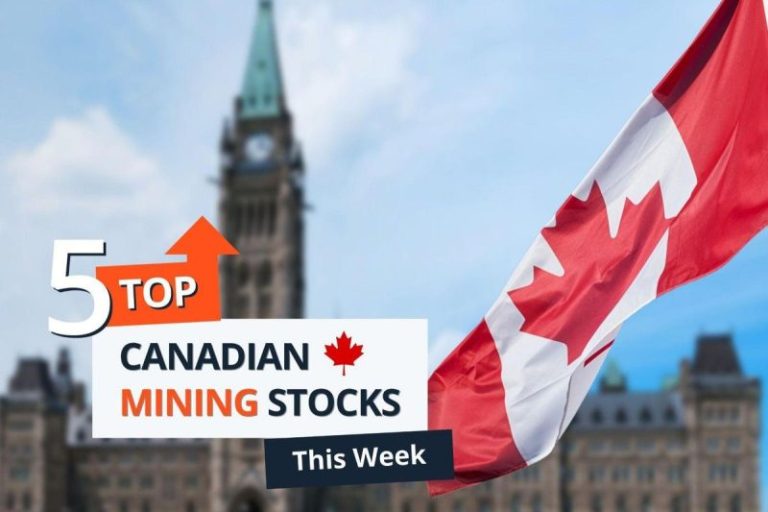
            Top Canadian mining stocks this week

            How did mining stocks perform against this backdrop?

            Take a look at this week’s five best-performing Canadian mining stocks below.

            Stocks data for this article was retrieved at 4:00 p.m. EDT on Friday using TradingView’s stock screener. Only companies trading on the TSX, TSXV and CSE with market caps greater than C$10 million are included. Mineral companies within the non-energy minerals, energy minerals, process industry and producer manufacturing sectors were considered.

            1. JZR Gold (TSXV:JZR)

            Weekly gain: 112.77 percent
            Market cap: C$28.95 million
            Share price: C$0.50

            JZR Gold is a gold company with exposure to the Vila Nova gold project, located in Amapá, Brazil, through a joint venture royalty agreement with the project’s operator, ECO Mining Oil & Gaz Drilling and Exploration.

            JZR received a 50 percent net profit interest in the Vila Nova project following the completion of payments totaling US$6 million to ECO in January 2023. The funds were used to advance the project and construct an 800 metric ton per day bulk sampling gravimetric mill at the site.

            According to JZR, the funding is considered a loan and will be “repaid to the Company from the proceeds of the sale of any products, prior to the distribution of any profits.”

            The project holds approximately 9 million metric tons of gold tailings grading an average of 2.47 grams per metric ton (g/t) gold from historic operations. The companies plan to reprocess the tailings to generate near-term cash flow that will fund further exploration at the site, anticipating production of 2 kilograms of gold per day.

            Shares gained this week alongside the October 14 news that ECO produced the first gold concentrate from the Vila Nova gold project’s mill. JZR said that ECO has begun to stockpile material at the mill site as it continues testing and optimization, with the goal of improving efficiency and increasing throughput.

            2. Austral Gold (TSXV:AGLD)

            Weekly gain: 90 percent
            Market cap: C$75.37 million
            Share price: C$0.095

            Austral Gold is a gold production company operating two mines in Latin America.

            Its Guanaco – Amancaya mine complex in Chile is its primary operation, hosting a 1,500 metric ton per day milling circuit, a 3,000 metric ton per day crushing circuit and a heap leaching processing plant. In 2024, the complex produced 15,138 ounces of gold and 37,154 ounces of silver.

            Austral’s other operation is the Casposo – Manantiales complex in Argentina, which hosts a 1,100 metric ton per day mill and a dry-stack tailings facility. The mine had been on care and maintenance since 2019, during which time Austral worked on exploration at the site, along with its refurbishment plan to restart operations.

            Shares in Austral rose this week following a pair of announcements on Tuesday.

            The first was a report that Austral has resumed production at Casposo, currently sourcing material from the existing stockpiles. The company said it plans to transition to open-pit mining and is in negotiations with a contractor to finalize an agreement.

            The company produced 230 gold equivalent ounces of doré during the commissioning phase, which began in December 2024, according to the release. It expects Casposo to produce 4,000 to 6,000 gold equivalent ounces during Q4.

            In the other release, Austral provided an updated mineral reserve estimate for Casposo reporting proven and probable gold contained to be 80,000 ounces of gold and 3.28 million ounces of silver with average grades of 1.31 g/t gold and 58.52 g/t silver from 2.15 million metric tons of ore.

            3. Resouro Strategic Metals (TSXV:RSM)

            Weekly gain: 88.64 percent
            Market cap: C$29.14 million
            Share price: C$0.415

            Resouro Strategic Metals is a polymetallic exploration and development company working to advance its mineral properties in Brazil.

            Its Tiros rare earth metals and titanium project is located in Minas Gerais, Brazil, and comprises 28 mineral rights covering an area of 497 square kilometers.

            According to a May 2025 technical report, the site hosts a measured and indicated resource of 1.4 billion metric tons of ore grading 12 percent titanium dioxide and 4,000 parts per million of total rare earth content.

            The company also owns the Novo Mundo gold project located in the Alta Floresta gold province in Central Brazil. It consists of three licenses totaling 167 square kilometers.

            On Tuesday, Resouro provided an update to its ongoing private placement, noting that it had received subscription agreements and expects to close in the next week.

            4. Nio Strategic Metals (TSXV:NIO)

            Weekly gain: 75 percent
            Market cap: C$16.24 million
            Share price: C$0.175

            Nio Strategic Metals is an exploration company working to advance its assets in Québec, Canada.

            Its primary focus has been on its Oka rare earth and critical minerals project. The property hosts a past-producing niobium mine and several nearby mineralized zones.

            According to the project page, Oka’s total measured and indicated resource is 10.63 million metric tons of ore at an average grade of 0.65 percent niobium oxide.

            While the company did not release any news this week, shares in Nio Strategic Metals rose significantly.

            5. Boron One (TSXV:BONE)

            Weekly gain: 71 percent
            Market cap: C$14.92 million
            Share price: C$0.06

            Boron One is an exploration company focused on advancing its Piskanja project located near Belgrade, Serbia.

            The asset hosts two primary densely mineralized zones with gently undulating borate beds. The company was initially granted its exploration license in 2010, with the exclusive right to apply for a mining license.

            In a preliminary economic assessment for the project released in June 2022, Boron One, then named Erin Ventures, reported an economic case with an after-tax, net present value of US$524.9 million with an internal rate of return of 78.7 percent and a payback period of 12 months.

            It also provided a mineral resource statement that demonstrated a measured and indicated resource of 2.36 million metric tons of boric oxide from 6.87 million metric tons of ore with an average grade of 34.36 percent boric oxide.

            The most recent news from the project came on September 26 when the company provided an update on its application for a mining license, noting the Ministry of Mining has requested amendments to the company’s application before it can be approved.

            Boron One said it is preparing the revised version “as quickly as possible.”

            FAQs for Canadian mining stocks

            What is the difference between the TSX and TSXV?

            The TSX, or Toronto Stock Exchange, is used by senior companies with larger market caps, and the TSXV, or TSX Venture Exchange, is used by smaller-cap companies. Companies listed on the TSXV can graduate to the senior exchange.

            How many mining companies are listed on the TSX and TSXV?

            As of May 2025, there were 1,565 companies listed on the TSXV, 910 of which were mining companies. Comparatively, the TSX was home to 1,899 companies, with 181 of those being mining companies.

            Together, the TSX and TSXV host around 40 percent of the world’s public mining companies.

            How much does it cost to list on the TSXV?

            There are a variety of different fees that companies must pay to list on the TSXV, and according to the exchange, they can vary based on the transaction’s nature and complexity. The listing fee alone will most likely cost between C$10,000 to C$70,000. Accounting and auditing fees could rack up between C$25,000 and C$100,000, while legal fees are expected to be over C$75,000 and an underwriters’ commission may hit up to 12 percent.

            The exchange lists a handful of other fees and expenses companies can expect, including but not limited to security commission and transfer agency fees, investor relations costs and director and officer liability insurance.

            These are all just for the initial listing, of course. There are ongoing expenses once companies are trading, such as sustaining fees and additional listing fees, plus the costs associated with filing regular reports.

            How do you trade on the TSXV?

            Investors can trade on the TSXV the way they would trade stocks on any exchange. This means they can use a stock broker or an individual investment account to buy and sell shares of TSXV-listed companies during the exchange’s trading hours.

            Article by Dean Belder; FAQs by Lauren Kelly.

            Securities Disclosure: I, Dean Belder, hold no direct investment interest in any company mentioned in this article.

            Securities Disclosure: I, Lauren Kelly, hold no direct investment interest in any company mentioned in this article.


            This post appeared first on investingnews.com